
What Are the Benefits of Web Scraping Real-Time and Batch Data Delivery Models for Faster BI Decisions?
May 13
Introduction
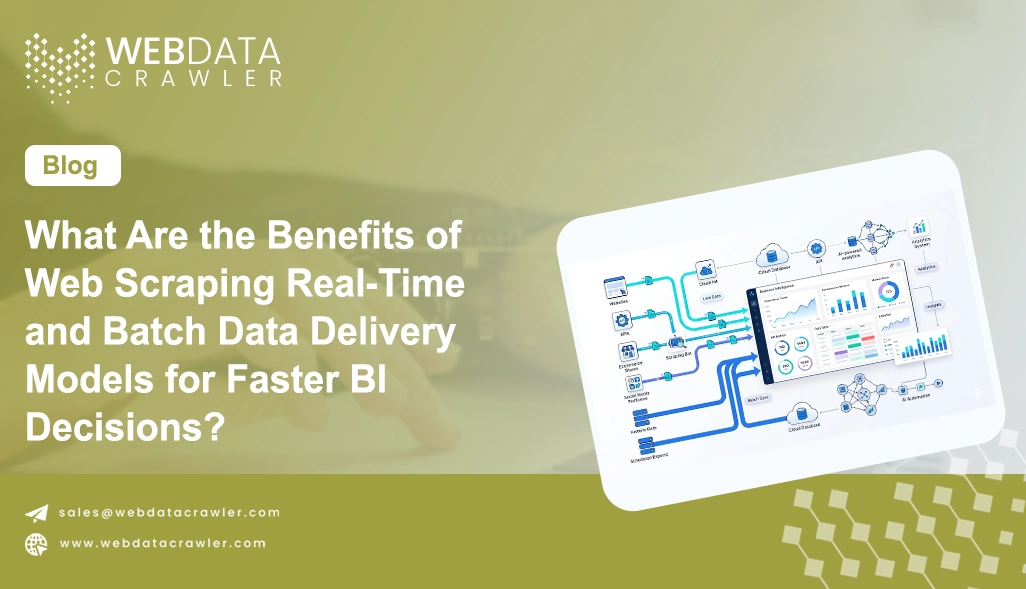
Organizations increasingly depend on accurate external data to support dashboards, forecasting, and executive reporting. Business intelligence platforms work best when they receive structured inputs from websites, marketplaces, public directories, and customer-generated platforms in formats that are ready for immediate analysis. This requirement has made Web Scraping Real-Time and Batch Data Delivery Models essential for companies that want operational decisions backed by current data rather than delayed reports.
A recent enterprise analytics study shows that 68% of BI teams reported delayed insights due to inconsistent third-party data synchronization. Real-time ingestion helps monitor live changes, while batch collection supports deeper historical analysis and large-volume processing. Organizations implementing Web Scraping Services often use both approaches together to ensure tactical and strategic reporting align.
Batch delivery, meanwhile, supports scheduled datasets that help build long-term performance trends. This combined approach strengthens enterprise decision-making, improves automation, and ensures leadership teams act on consistent intelligence from every channel. As more enterprises shift toward data-first operations, selecting the right scraping delivery framework becomes central to business success.
Improving Enterprise Decisions Through Timely Data Synchronization Frameworks

Businesses depend on external information to support dashboards, competitor tracking, and strategic planning. Industry studies show nearly 67% of analytics teams experience reporting delays because external datasets are not delivered in a structured schedule. This approach supports teams responsible for Market Research, where competitor changes, customer demand, and industry benchmarks need constant monitoring.
Real-time collection supports urgent decisions, while archived records help identify long-term patterns and recurring trends. Enterprises can improve both tactical response and strategic evaluation by combining both methods. Organizations increasingly adopt Scalable Real-Time Web Scraping Data Delivery to process live updates from public sources directly into BI dashboards. This allows operations teams to react faster to pricing changes, inventory shifts, or digital market trends.
Real-time feeds are especially useful when dashboards need instant updates to maintain business visibility. By combining both approaches, enterprises reduce delays and improve data readiness. Decision-makers can compare live changes against stored historical records, creating more accurate analysis for leadership planning and operational reporting.
| Data Delivery Model | Operational Advantage |
|---|---|
| Live Synchronization | Faster reporting updates |
| Scheduled Collection | Historical trend analysis |
At the same time, historical reporting remains essential. Businesses use Automated Batch Data Extraction Services to collect large volumes of data at fixed intervals, ensuring consistency for monthly reporting and internal reviews. This structure supports stronger forecasting and resource planning across departments.
Solving Operational Gaps Through Combined Processing Methods
Organizations often struggle when business intelligence systems receive fragmented datasets. Inconsistent collection creates missing records, incomplete dashboards, and delayed reports. This model is highly effective for customer feedback tracking. Companies using Review Scraping Services require immediate visibility into public sentiment changes while maintaining historical records for monthly trend analysis. Combining both methods creates a complete view of customer behavior.
Enterprises often deploy Real-Time vs Batch Data Pipelines for Modern Enterprises via Scraper to balance speed and scalability. Live pipelines capture immediate changes, while batch workflows support large-volume analysis. This ensures teams receive relevant information without overwhelming infrastructure. The hybrid framework also improves resilience. If live connectors fail or sources become unavailable, scheduled extraction ensures reporting continuity.
This prevents operational blind spots and supports uninterrupted data analysis across departments. Organizations using combined delivery systems report improved dashboard accuracy, stronger forecasting, and better decision support. By synchronizing collection pipelines, enterprises gain a balanced infrastructure that supports both urgent operational actions and strategic analysis.
| Pipeline Approach | Enterprise Benefit |
|---|---|
| Continuous Feed | Immediate visibility |
| Bulk Processing | Long-term reporting |
For enterprises processing millions of records, Batch Data Processing for Large-Scale Web Scraping improves consistency. Scheduled exports reduce server load, simplify storage management, and create structured datasets for deeper analysis. This is especially useful for executive reports that depend on historical comparisons.
Strengthening Business Intelligence With Scalable Delivery Systems

As organizations expand digital monitoring, managing millions of records becomes a challenge. Business intelligence systems require structured external data to support forecasting, benchmarking, and internal analysis. Research shows 71% of enterprises prioritize scalable ingestion frameworks to maintain reporting consistency. This is particularly important for Pricing Intelligence, where competitor price changes directly impact revenue decisions.
Companies need immediate visibility into market changes while retaining historical pricing records for trend comparisons. Combining both delivery models ensures stronger commercial analysis. Enterprises often use Enterprise Batch Data Integration Solutions via Crawler to transfer scheduled datasets into warehouses and visualization tools.
This enables finance, operations, and analytics teams to access the same historical records for reporting and strategic planning. At the same time, scalable systems depend on balanced infrastructure. Real-time pipelines capture urgent signals, while batch exports support archive creation and performance benchmarking. This approach reduces processing pressure and supports enterprise-wide reporting.
| Scalable Method | Reporting Outcome |
|---|---|
| Enterprise Integration | Unified analytics |
| Structured Delivery | Better forecasting |
By implementing scalable frameworks, organizations improve operational efficiency and reduce delays in intelligence workflows. These models support stronger forecasting, competitive benchmarking, and executive planning. As data volume grows, synchronized delivery remains essential for maintaining accurate business reporting.
How Web Data Crawler Can Help You?
Modern enterprises need dependable external datasets that align with reporting systems and automation workflows. Many organizations improve decision cycles by adopting Web Scraping Real-Time and Batch Data Delivery Models to match operational and analytical needs.
- Collect structured web data from multiple platforms
- Deliver scheduled and live feeds
- Connect outputs to BI dashboards
- Standardize external datasets
- Reduce manual processing overhead
- Support enterprise-scale analytics
Businesses that need long-term reporting accuracy also rely on customized delivery frameworks for integration across departments. Advanced deployment includes Scalable Real-Time Web Scraping Data Delivery to ensure analytics teams receive structured updates for immediate actions and consistent enterprise reporting.
Conclusion
Organizations that combine real-time updates with scheduled processing improve business intelligence reliability and speed. Web Scraping Real-Time and Batch Data Delivery Models provide a practical framework for enterprises that depend on accurate external insights for decision-making.
Long-term success also depends on Enterprise Batch Data Integration Solutions via Crawler, which connect large datasets directly to enterprise dashboards. Build faster BI systems with expert scraping solutions. Contact Web Data Crawler today to modernize your data delivery workflow.