
What Drives Web Scraping for New Product Launch Monitoring for Insights Across Retail Trends in 2026?
May 18
Introduction
Retail product cycles are moving faster than ever, and brands can no longer rely on manual tracking to understand when competitors release new items. In 2026, digital marketplaces launch thousands of products every day, making real-time tracking essential for strategic planning. This is where Web Scraping for New Product Launch Monitoring for Insights becomes critical for businesses that need early access to product intelligence before market shifts become visible.
Global ecommerce platforms introduced over 34 million new SKUs in 2025 alone, according to retail intelligence reports, and nearly 61% of those launches included promotional pricing during the first two weeks. This indicates how quickly brands adjust product positioning based on demand. Companies using Competitor Price Monitoring can compare launch timing, pricing gaps, and assortment changes to improve merchandising decisions and reduce delayed responses.
New product tracking also helps identify category saturation, promotional launches, and geographic rollouts. Businesses can map when specific brands expand into new markets, which product lines receive priority, and how fast pricing is adjusted after release. Instead of waiting for quarterly reports, data teams use automated extraction pipelines to build launch dashboards daily, helping organizations react faster to changing retail trends and emerging product segments.
Capturing Product Entry Timing Across Retail Channels

Retail product introductions now happen across marketplaces at different speeds, making timing analysis essential for competitive planning. Companies monitor when a product appears, how it is positioned, and whether launch timing varies by geography or seller channel. This visibility helps identify which brands release products in phases and which use simultaneous rollouts for market impact.
Businesses increasingly rely on Pricing Intelligence to compare launch timing with initial pricing shifts. This helps teams understand whether brands introduce products at premium pricing, discounted entry, or region-specific promotional rates. Many companies use Scrape New Product Arrivals for Ecommerce processes to monitor these changes across multiple websites and marketplaces.
| Tracking Element | Business Use |
|---|---|
| Listing date | Detect release timing |
| Initial price | Compare market position |
| Launch region | Identify rollout strategy |
| Category placement | Benchmark competitors |
Tracking also helps determine whether product launches are tied to promotional events, festive campaigns, or inventory cycles. Businesses compare how often certain categories receive new listings and how quickly those products move into discounting.
The process becomes more useful when businesses connect launch timing with Competitor Price Monitoring, enabling side-by-side comparisons of pricing strategies and category movement. Monitoring structured listing data also reveals hidden trends in category saturation and competitor assortment expansion.
Evaluating Price Signals and Product Listing Details
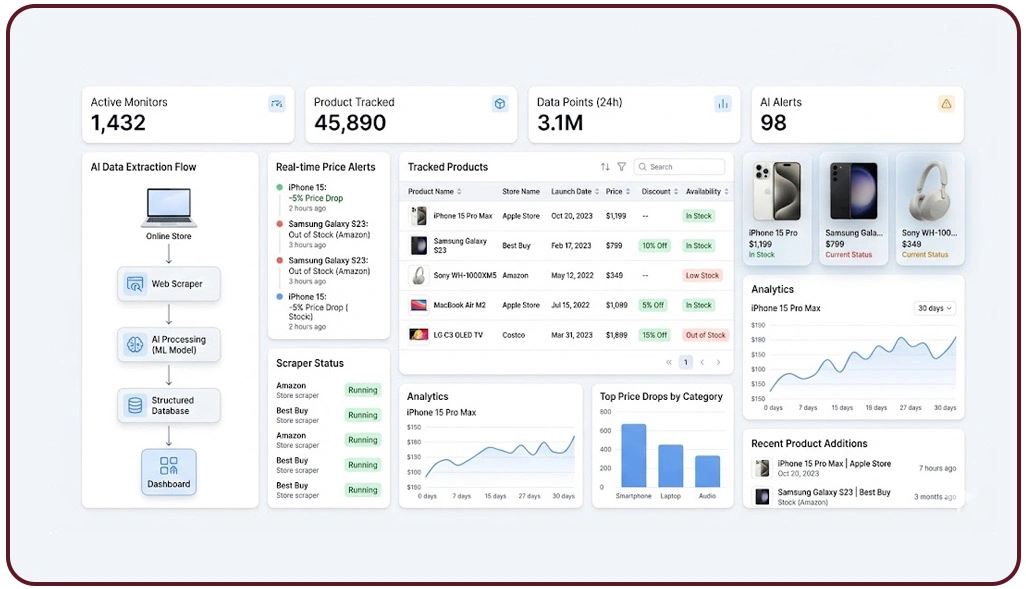
Price is one of the earliest indicators of a product’s positioning, but complete evaluation requires examining listing attributes alongside launch data. Businesses compare titles, descriptions, variants, promotional tags, and availability to understand how products are introduced to the market. These details reveal strategic differences between premium launches, seasonal promotions, and budget-oriented product entries across ecommerce channels.
Organizations using Web Scraping Ecommerce Data can capture structured information immediately after product release. Reports indicate that 59% of newly introduced online products experience description or visual changes within ten days, showing that brands continuously adjust launch listings based on consumer interaction. Businesses use Extract Launch Date and Price of New Products From Online Stores to compare these changes across platforms.
| Product Attribute | Strategic Insight |
|---|---|
| Price point | Positioning analysis |
| SKU variation | Assortment comparison |
| Promotion tag | Discount evaluation |
| Stock status | Demand visibility |
A complete product record often includes images, titles, attributes, reviews, and category placement. Businesses asking What Data Can Be Scraped From a New Product Listing? usually focus on identifying the full product context beyond price. This allows analysts to compare how competitors position similar products and how listings evolve after launch.
These insights also support category forecasting and assortment planning. When brands repeatedly update descriptions, images, or bundled items, it often indicates demand testing. Businesses can use this data to identify launch success factors and optimize product introduction strategies within fast-changing retail environments.
Identifying Retail Shifts Through Automated Detection
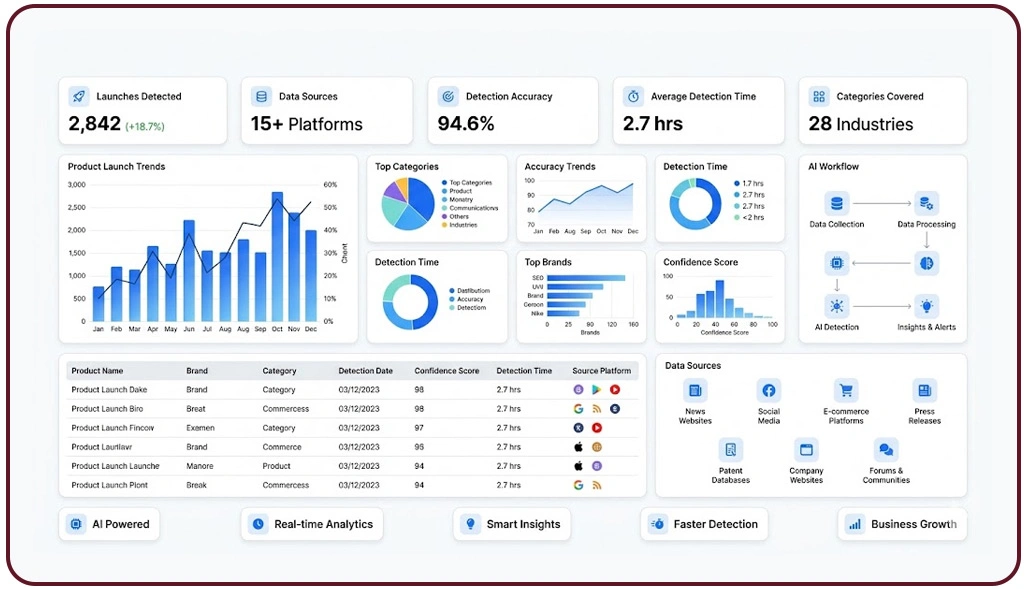
Monitoring new products helps organizations detect emerging trends before they become visible through sales reports. By analyzing recurring product launches, businesses can identify category growth, regional demand patterns, and competitor expansion strategies. These observations are particularly valuable when brands introduce multiple related products within a short time frame, signaling a broader market trend.
A Web Crawler collects listing changes across marketplaces and transforms scattered updates into structured intelligence. Studies show that nearly 46% of high-performing retail categories begin showing repeated product launches three months before significant sales growth. Many organizations use Product Launch Detection Using AI to classify products and detect similar launch clusters across categories and regions.
| Trend Signal | Business Outcome |
|---|---|
| Launch repetition | Demand prediction |
| Brand frequency | Expansion tracking |
| Category surge | Growth analysis |
| Price variation | Market response |
Automated systems identify patterns such as repeated launches by different brands, localized product tests, and phased category expansion. This provides visibility into hidden product strategies that may not appear in standard reports. Businesses can compare how categories evolve based on release frequency and promotional support.
Retail teams also track product reviews, stock movement, and pricing changes alongside launch data to understand acceptance. When structured correctly, automated launch monitoring provides a broader picture of retail movement and supports stronger decisions for product strategy, category forecasting, and market expansion planning.
How Web Data Crawler Can Help You?
Retail intelligence depends on structured collection methods that turn raw listings into actionable insights. Businesses using Web Scraping for New Product Launch Monitoring for Insights can monitor launch activity across marketplaces and understand changes before they impact pricing or demand.
We help organizations build customized product monitoring workflows to:
- Track new listings across marketplaces
- Capture launch timing in real time
- Compare regional release strategies
- Analyze assortment expansion
- Monitor pricing updates
- Generate structured reporting dashboards
Our solutions support scalable data extraction for retailers, marketplaces, and analytics teams. Product Launch Price Point Monitoring via API helps integrate structured launch pricing directly into business intelligence systems for deeper analysis.
Conclusion
Retail markets continue accelerating, making launch visibility a strategic requirement for brands competing in dynamic ecommerce environments. Businesses relying on Web Scraping for New Product Launch Monitoring for Insights can identify launch patterns, pricing shifts, and product rollout strategies before they reshape category demand.
Organizations using automated tracking also improve forecasting by understanding launch timing, assortment movement, and pricing changes. Product Launch Detection Using AI supports faster response to market shifts and helps teams build stronger retail strategies. Connect with Web Data Crawler today to transform product launch monitoring into actionable retail intelligence.