
How Do Businesses Choose Between a Web Scraping API vs Official API for Business Intelligence in 2026?
June 03
Introduction
Business intelligence in 2026 depends heavily on accurate, scalable, and real-time data collection. Organizations across retail, finance, travel, healthcare, and eCommerce sectors increasingly rely on external data sources to monitor competitors, understand customer behavior, identify market opportunities, and improve operational decisions. As data requirements continue to expand, companies often face a critical decision when building their data acquisition strategy.
The debate surrounding Web Scraping API vs Official API for Business Intelligence has become more relevant than ever because both methods offer distinct advantages and limitations. While official APIs provide structured and authorized access to platform data, businesses often encounter restrictions related to quotas, pricing, permissions, and data availability.
On the other hand, a Web Scraping API can access publicly available information across websites and digital platforms, providing broader visibility into market conditions. Choosing the right approach depends on multiple factors, including scalability requirements, budget allocation, compliance considerations, and business objectives. Companies seeking competitive insights frequently evaluate the depth, freshness, and reliability of data before selecting a solution.
Building Effective Strategies For Broader Market Visibility
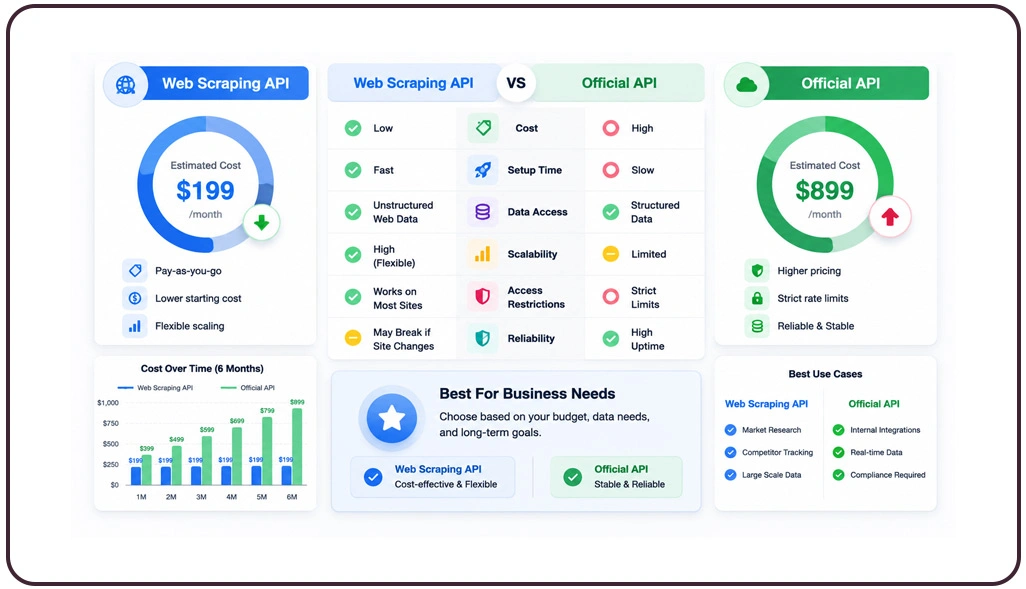
Organizations gathering external intelligence often begin by evaluating how much information they need and whether available sources can support their business goals. Access to complete, relevant, and timely data is increasingly important as companies expand competitive monitoring, pricing analysis, customer research, and trend forecasting initiatives.
Official APIs provide structured access to selected datasets, but the information exposed is often limited by platform policies. As organizations seek wider visibility, alternative collection methods become valuable. This is particularly true when enterprises require continuous updates from multiple digital sources. In such cases, Live Crawler Services support automated monitoring and help businesses maintain current datasets for analysis.
Decision-makers frequently conduct a Cost Comparison of Web Scraping APIs and Official APIs before investing in large-scale data programs. As data volumes continue growing, organizations increasingly prioritize flexible collection systems that can adapt to changing business requirements while maintaining accuracy and operational efficiency across multiple markets.
| Evaluation Area | Structured API Access | Alternative Data Collection |
|---|---|---|
| Data Availability | Controlled | Extensive |
| Competitive Research | Partial | Broad |
| Marketplace Tracking | Limited | Comprehensive |
| Update Frequency | Platform Defined | Flexible |
| Expansion Capability | Moderate | High |
Companies also assess Web Scraping API vs Official API for Business Data when determining which method aligns best with long-term intelligence objectives. A broader data strategy often provides greater visibility into market changes, consumer behavior, and competitor activities.
Measuring Financial Sustainability And Growth Potential
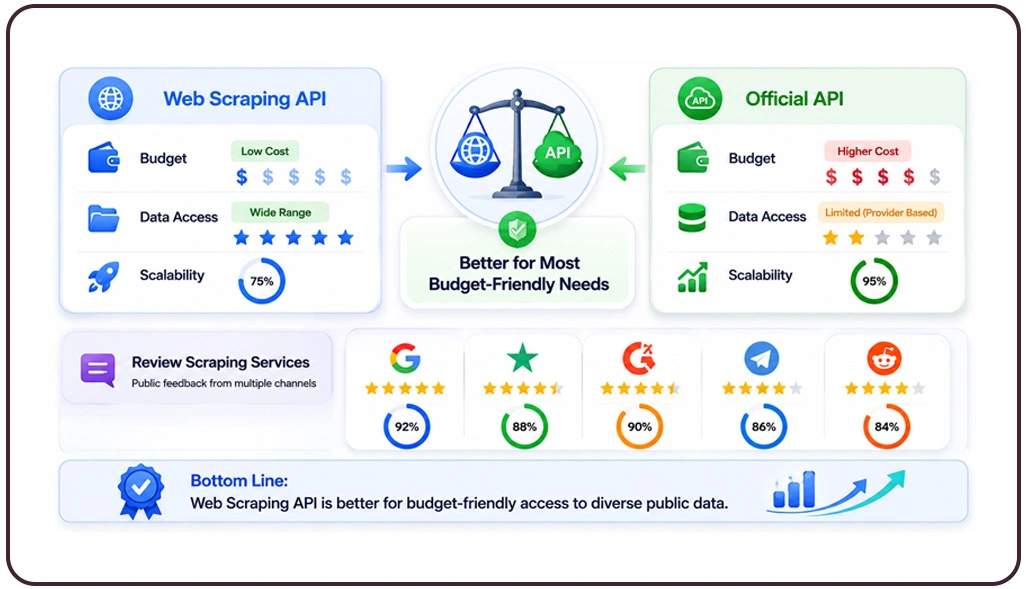
Scalability and cost efficiency play a major role in selecting a data acquisition approach. As organizations expand their business intelligence initiatives, the volume of information required for analysis often increases significantly. What works for a small project may become expensive or restrictive when applied across multiple regions, products, and business units.
Many official API providers operate under tiered pricing structures that increase costs as usage grows. These expenses may include access fees, request limitations, premium endpoint charges, and licensing requirements. When comparing available approaches, organizations often ask Which Is Better Web Scraping API or Official API based on budget constraints, data requirements, and scalability goals.
Organizations monitoring customer sentiment frequently utilize Review Scraping Services to gather publicly available feedback from multiple digital channels. These datasets contribute to customer experience analysis, brand monitoring, and product development initiatives.
| Cost Consideration | Structured API Access | Flexible Collection Method |
|---|---|---|
| Access Charges | Often Recurring | Variable |
| Request Limits | Common | Fewer Restrictions |
| Scaling Expenses | Increase Over Time | More Predictable |
| Vendor Dependence | Higher | Lower |
| Data Coverage | Controlled | Broader |
Industry forecasts suggest external data consumption will continue rising throughout the decade. Businesses preparing for future growth must therefore select solutions capable of handling increasing information demands without creating operational bottlenecks. Financial planning should also account for maintenance, integration, and expansion costs.
Improving Insight Quality Through Better Data Collection
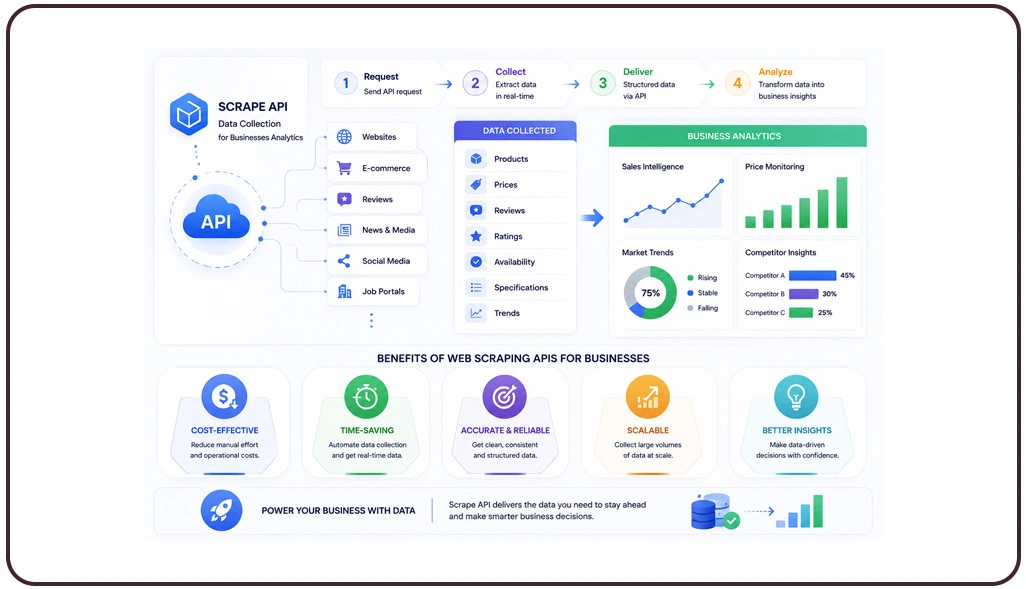
The effectiveness of any intelligence initiative depends on the quality, relevance, and timeliness of collected information. Businesses increasingly rely on external datasets to identify emerging opportunities, understand customer preferences, monitor competitors, and improve forecasting accuracy.
Selecting the right collection approach directly influences the depth of insights available to decision-makers. Modern enterprises often adopt Web Scraping Services to support comprehensive intelligence programs across multiple industries. These services help organizations gather information from publicly available sources and convert raw data into actionable business insights.
Research consistently shows that companies combining diverse external datasets with internal analytics improve strategic planning outcomes and respond more effectively to changing market conditions. Organizations focused on advanced analytics frequently implement Scrape API Data Collection for Businesses Analytics to improve visibility into market behavior and consumer activity.
| Intelligence Objective | Structured API Access | Expanded Collection Approach |
|---|---|---|
| Market Analysis | Moderate | Extensive |
| Consumer Insights | Platform Specific | Multi-Source |
| Trend Monitoring | Limited | Comprehensive |
| Competitive Intelligence | Partial | Broad |
| Strategic Forecasting | Good | Enhanced |
Organizations evaluating the Benefits of Web Scraping APIs for Businesses Data Scraping often recognize the value of broader market visibility, improved analytical depth, and enhanced strategic planning. By focusing on data quality and business objectives, enterprises can build intelligence frameworks that support sustainable growth and informed decision-making across evolving digital markets.
How Web Data Crawler Can Help You?
Modern organizations require scalable and reliable solutions to transform publicly available information into actionable intelligence. When evaluating Web Scraping API vs Official API for Business Intelligence, businesses often seek solutions that provide flexibility, scalability, and consistent data delivery.
We support organizations through:
- Collecting large-scale market information from diverse sources
- Monitoring competitor activities across multiple industries
- Tracking pricing trends and product availability
- Capturing consumer sentiment from public platforms
- Delivering customized datasets for analytics teams
- Supporting enterprise-scale data integration workflows
With extensive experience in external data acquisition, automation, and intelligence solutions, organizations can streamline research processes while improving decision-making capabilities. Companies looking to strengthen market visibility often recognize the Benefits of Web Scraping APIs for Businesses Data Scraping when building scalable business intelligence ecosystems.
Conclusion
As organizations expand their data-driven initiatives, selecting the right collection strategy becomes increasingly important. The debate surrounding Web Scraping API vs Official API for Business Intelligence ultimately depends on data accessibility requirements, scalability expectations, compliance needs, and analytical objectives.
Organizations seeking broader market visibility often evaluate Which Is Better Web Scraping API or Official API based on long-term business goals and operational requirements. Ready to build a scalable intelligence strategy? Contact Web Data Crawler today to transform external data into actionable business insights.