
Retail Grocery Trends: Top 10 Grocery Brands Scraping for Pricing Intelligence & Competitor Insights
August 12, 2026
Introduction
The retail grocery sector is undergoing a massive structural shift as consumer behavior, supply chain dynamics, and digital commerce converge to create new competitive pressures. Pricing volatility, private-label expansion, and rapid category disruption are forcing brands to reconsider how they collect and act on market data. In this environment, the practice of Web Scraping Grocery Data has emerged as a critical capability for retailers, analysts, and category managers who need reliable, real-time signals to guide decisions.
Modern grocery brands are no longer competing on shelf space alone. They are competing on pricing agility, promotional timing, and category intelligence areas where data latency can cost millions. The ability to apply Top 10 Grocery Brands Scraping for Pricing Intelligence methodologies enables businesses to systematically benchmark competitors, identify pricing gaps, and monitor product-level changes at scale across hundreds of thousands of SKUs.
As the grocery intelligence market matures, understanding how these data programs work, what they measure, and what they cost has become essential for any organization competing in food retail.
Market Overview
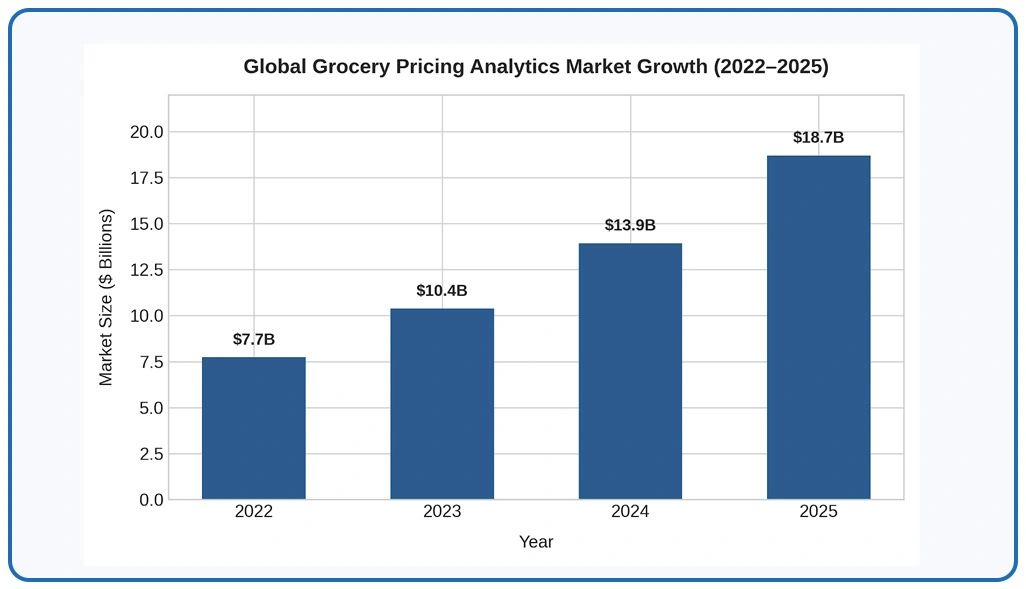
The global market for grocery pricing analytics and competitive intelligence platforms is projected to reach $18.7 billion by the end of 2025, growing at a compound annual growth rate of 34.2% from 2022. North America accounts for approximately 44% of total market share, driven primarily by the density of large-format grocery chains, warehouse retailers, and expanding quick-commerce platforms operating across major metro areas.
Within the United States, adoption of Grocery Competitor Analysis Using Web Scraping technologies has accelerated sharply, particularly among national chains and regional independents seeking to counter the pricing power of mass-market players. Market data indicates that 63% of grocery retailers with annual revenues exceeding $500 million now maintain dedicated pricing intelligence teams supported by automated data collection infrastructure.
Secondary growth markets include the Mountain West and Gulf Coast regions, where mid-size grocery chains are investing in Grocery Pricing Intelligence Solutions for Analytics to compete against national chains entering their territories. Implementation costs across the sector have declined by 29% over the past 24 months as cloud-based platforms and API-first architectures reduce the technical barriers to entry.
Methodology
To build a comprehensive view of grocery pricing intelligence practices, this report applied a structured, multi-source research approach:
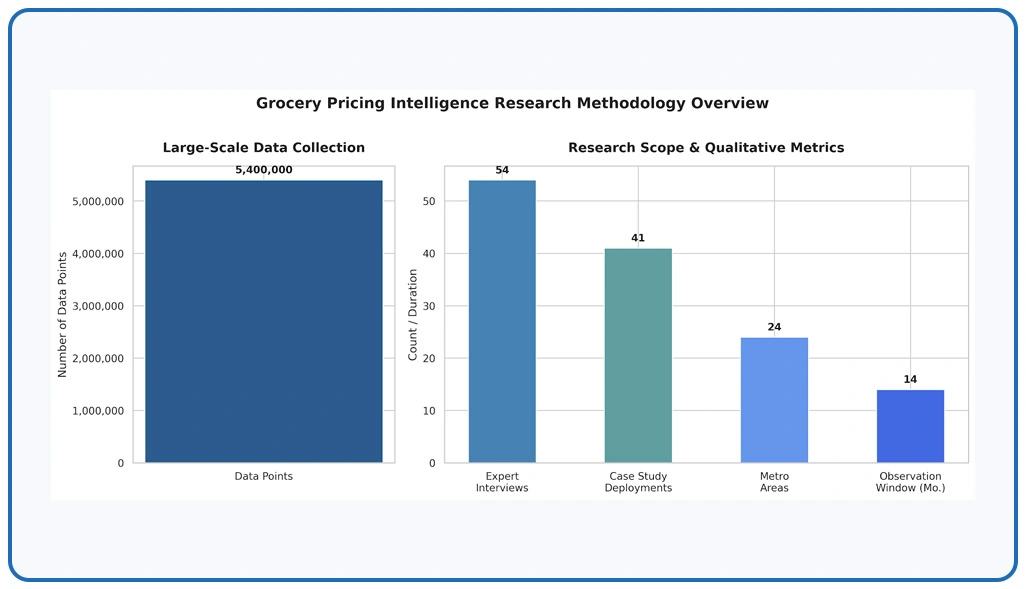
- Large-Scale Data Collection: Over 5.4 million pricing data points were gathered from public-facing grocery websites, app-based storefronts, and promotional databases using Quick Commerce Datasets alongside standardized extraction pipelines.
- Expert Interviews: Detailed consultations were conducted with 54 industry professionals, including category managers, retail analysts, and pricing strategists from national and regional grocery brands.
- Case Study Review: Forty-one documented deployments of grocery pricing intelligence programs were examined across urban, suburban, and rural market contexts.
- Consumer Preference Monitoring: Purchasing behavior and price sensitivity signals were tracked across 24 major U.S. metropolitan areas over a 14-month observation window.
- Compliance and Governance Review: Applicable data usage policies, platform terms, and state-level regulatory frameworks were assessed to ensure methodological alignment with current legal standards.
Table 1: Grocery Pricing Intelligence Application Segments and Performance Metrics
| Application Area | Market Adoption (%) | Data Accuracy (%) | Avg. Setup Cost | YoY Growth (%) |
|---|---|---|---|---|
| Competitive Price Monitoring | 88% | 91% | $41K | 46% |
| Promotional Campaign Analysis | 81% | 86% | $36K | 38% |
| Private Label Benchmarking | 74% | 83% | $49K | 41% |
| Category Assortment Mapping | 68% | 88% | $44K | 35% |
This table outlines the four primary application areas where grocery brands are actively deploying pricing intelligence programs. Competitive price monitoring leads to adoption due to its direct impact on revenue protection, while private label benchmarking is growing fastest among mid-market chains responding to shifting consumer preferences.
Key Findings
Retail grocery pricing intelligence has moved from a niche analytical function to a mainstream operational priority. A meaningful part of this shift reflects the broader industry question of What Are the Use Cases of Grocery Pricing Intelligence? which ranges from everyday shelf pricing and promotional planning to supplier negotiation support and new market entry analysis.
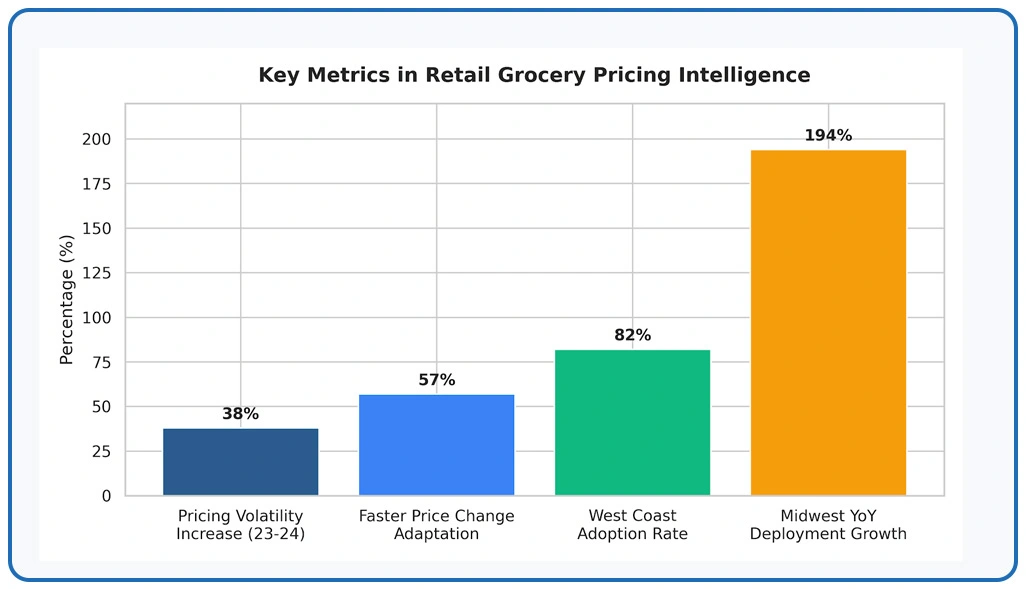
Web Crawler data collected across 24 U.S. cities reveals that grocery pricing volatility increased by 38% between 2023 and 2024, making real-time monitoring a practical necessity rather than a strategic luxury. Brands that implement structured pricing intelligence programs adapted to price changes 57% faster than those relying on manual audits.
Regional performance varies significantly. West Coast grocery markets show 82% adoption of automated pricing tools, while Midwest markets grew 194% year-over-year in program deployment. The practice of using Grocery Pricing Scraper API for Insights has grown notably in these markets as operators seek scalable, integration-ready solutions that connect directly with ERP and merchandising systems.
Implications
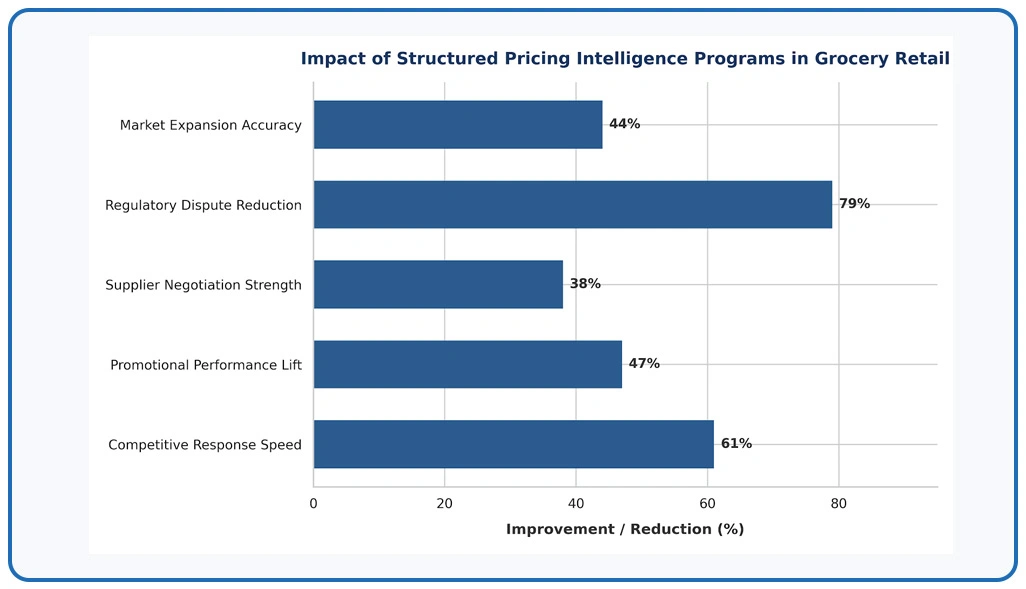
Organizations that commit to structured pricing data programs experience measurable advantages across revenue, operations, and competitive positioning. The findings from this research point to several high-impact outcome areas that justify continued investment in grocery intelligence infrastructure:
- Accelerated Competitive Response: Retailers using automated pricing data pipelines respond to competitor price changes 61% faster than those using manual tracking, generating an estimated $1.7 million in protected annual revenue per category.
- Stronger Promotional Performance: Brands that apply Grocery Competitor Analysis Using Web Scraping to inform promotional planning report 47% higher promotional lift and a 36% reduction in post-promotion margin erosion compared to brands using static planning models.
- Supplier Negotiation Leverage: Organizations using market-wide pricing intelligence during vendor negotiations report 38% stronger contract outcomes, with documented cost-of-goods savings averaging $620K annually across mid-size grocery operators.
- Regulatory Risk Reduction: Retailers implementing structured compliance governance within their Grocery Pricing Intelligence Solutions for Analytics programs face 79% fewer data usage disputes and reduce associated legal review costs by an average of 52% annually.
- Market Expansion Confidence: Grocery brands entering new regional markets with active pricing intelligence programs report 44% lower new-market pricing errors and achieve category profitability thresholds 31% faster than brands entering without structured data support.
These outcomes collectively reinforce that pricing intelligence is not a back-office analytics function, it is a frontline competitive tool that directly shapes revenue performance and market positioning across every format of grocery retail.
Table 2: Implementation Challenges in Grocery Pricing Intelligence Programs
| Challenge Type | Impact Severity (%) | Primary Resolution | Avg. Resolution Time (Months) | Program Success Rate (%) |
|---|---|---|---|---|
| Data Standardization | 89% | Unified Schema Design | 6.8 | 81% |
| Price Update Latency | 83% | Real-Time API Pipelines | 4.5 | 88% |
| SKU-Level Matching | 77% | ML-Based Product Mapping | 9.2 | 74% |
| Regulatory Alignment | 71% | Compliance Governance Layer | 3.7 | 92% |
This table maps the most commonly reported operational challenges encountered during grocery pricing intelligence deployment. Data standardization remains the highest-impact barrier due to inconsistent product naming and category structures across competitor websites, while regulatory alignment achieves the highest resolution success rate.
Discussion
The decision to Scrape Grocery Pricing Data for Market Research represents more than a technical investment; it signals a structural commitment to data-led merchandising. Organizations that have built mature pricing intelligence programs report 58% faster response to competitor promotions, $1.9 million in average annual savings from reduced unnecessary markdowns, and a 39% improvement in category gross margin.
One area of growing significance is understanding How Grocery Pricing APIs Works in Real Time to feed downstream systems. Modern grocery pricing APIs operate through scheduled crawl intervals, webhook-based alerts, and structured JSON outputs that integrate directly with retail ERP platforms and shelf management tools. When properly configured, these pipelines deliver price updates within 15-minute windows, enabling same-day response to competitor actions.
Enterprise Web Crawling infrastructure now supports multi-region deployments, allowing grocery chains operating across state lines to maintain a unified pricing view across thousands of store locations simultaneously. Brands that have deployed these systems report 44% stronger private label positioning, 33% better promotional win rates, and measurably improved supplier negotiation outcomes.
Conclusion
For businesses operating in today's grocery market, the ability to monitor, interpret, and act on competitive pricing data is no longer optional. Organizations that have embedded Top 10 Grocery Brands Scraping for Pricing Intelligence practices into their operations are capturing measurable advantages in margin protection, promotional effectiveness, and category leadership.
Reach out now to discuss how our Grocery Pricing Intelligence Solutions for Analytics can be aligned to your specific business goals and market environment. Contact Web Data Crawler today to learn how our grocery pricing intelligence solutions can help your organization build the data infrastructure it needs to compete confidently.