
How Can RERA Database Extraction for Construction Industry Insights Unlock Smarter Project Intelligence?
June 10
Introduction
The modern construction and real estate ecosystem is increasingly driven by structured data intelligence rather than manual reporting or fragmented updates. Developers, investors, and analysts now rely on regulated datasets to understand project timelines, compliance status, and delivery performance. Within this transformation, RERA Database Extraction for Construction Industry Insights has emerged as a critical approach to convert raw regulatory filings into actionable intelligence for decision-making.
It enables stakeholders to evaluate project authenticity, monitor approvals, and assess construction momentum in a more structured way. The integration of Real Estate Market Analysis Using RERA Data Scraping further enhances visibility into project pipelines, helping organizations interpret market behavior through verified records.
Instead of relying on assumptions or delayed reports, structured extraction enables faster interpretation of real estate activity across regions. This shift is also redefining transparency standards, where every project update contributes to a more reliable analytical framework for planners and investors seeking clarity in competitive environments.
Regulatory Data Fragmentation Across Construction Ecosystems

Real estate ecosystems often suffer from scattered regulatory information, making it difficult to achieve unified visibility across projects and regions. In such conditions, Real Estate Project Intelligence Through RERA Data becomes essential for building structured analytical frameworks that improve clarity and decision accuracy. Organizations conducting Real Estate Market Research Using RERA Datasets frequently encounter inconsistencies in data formatting, which slows down meaningful interpretation.
Another major limitation is manual dependency, where teams spend excessive time reconciling records instead of analyzing insights. This reduces operational efficiency and increases the risk of outdated reporting. In addition, regional disparities in data publishing standards make cross-state comparison highly complex.
Regulatory Data Comparison Overview:
| Issue Type | Business Impact | Frequency Level |
|---|---|---|
| Data inconsistency | Reduced visibility | High |
| Manual reconciliation | Delayed reporting | Medium |
| Regional format gaps | Poor benchmarking | High |
| Update latency | Inaccurate insights | High |
In many cases, firms fail to integrate RERA Data for Real Estate Investment Intelligence, resulting in incomplete investment evaluations and limited forecasting capability. This gap restricts the ability to identify emerging opportunities and assess project credibility effectively.
To address these challenges, organizations must shift toward structured systems that unify fragmented datasets into a single analytical layer. Without this transformation, real estate intelligence remains reactive rather than predictive, limiting long-term strategic planning and competitive positioning.
Scaling Construction Insights Through Automated Intelligence Systems
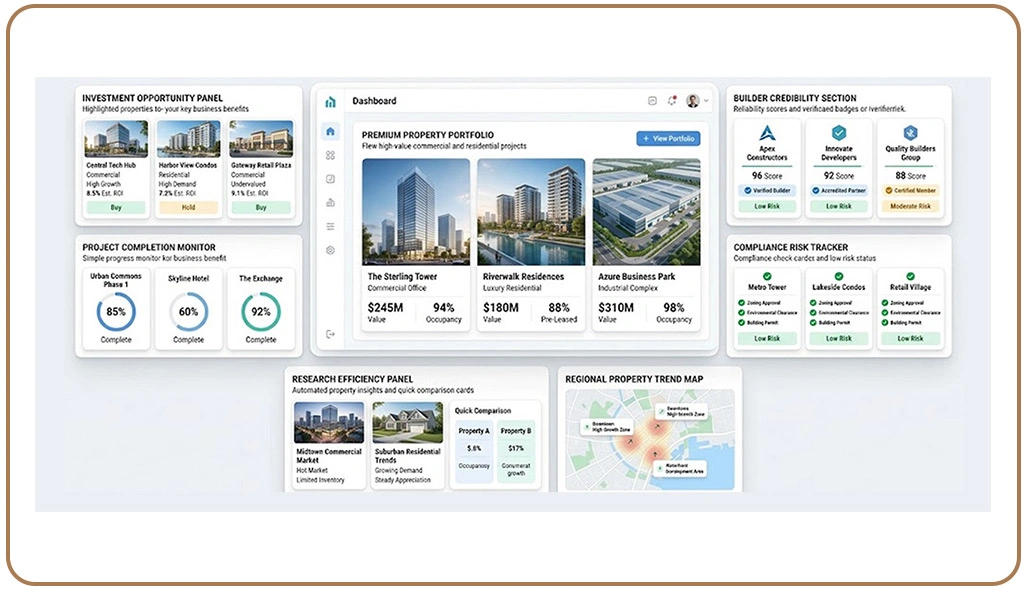
Modern real estate analytics requires scalable systems capable of handling continuous regulatory updates across multiple sources. In this context, Enterprise Web Crawling plays a critical role in aggregating structured and unstructured data, enabling faster transformation into actionable intelligence. This ensures that stakeholders can evaluate project pipelines and compliance records with greater accuracy.
One of the key advantages of automation is the ability to maintain consistent data flow without manual intervention. It significantly improves processing speed and reduces operational bottlenecks in large-scale analytics environments. Additionally, automated pipelines ensure better data standardization across different regulatory platforms.
System Efficiency Evaluation:
| Processing Method | Speed Level | Accuracy Rate | Scalability |
|---|---|---|---|
| Manual tracking | Low | Medium | Low |
| Semi-automated systems | Medium | High | Medium |
| Fully automated systems | High | Very High | High |
These improvements directly support Track Construction Project Progress With RERA Data Scraping, allowing organizations to monitor approvals, delays, and completion timelines with improved precision. It also enhances forecasting models by integrating real-time updates into analytical dashboards.
The use of automated systems further strengthens investment evaluation frameworks by reducing dependency on static reports. This ensures more dynamic decision-making and better alignment with evolving market conditions. Ultimately, automation helps transform raw regulatory data into structured intelligence that supports long-term strategic growth in the real estate sector.
Enhancing Market Visibility Through Project Listing Intelligence Systems
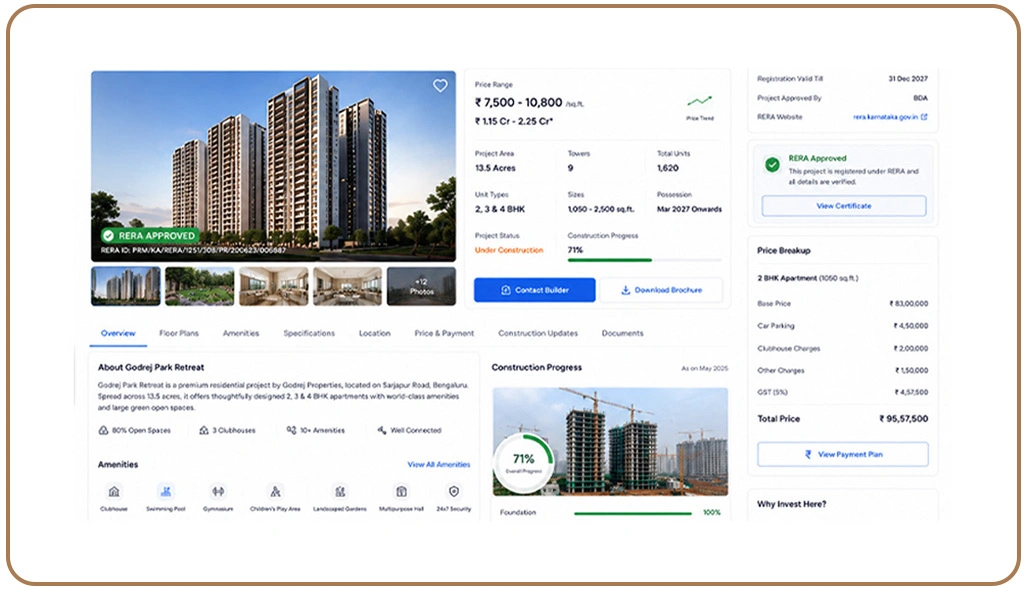
Understanding demand patterns in real estate requires detailed visibility into project-level listings and their lifecycle progression. RERA Property Listings for Demand Analysis enables stakeholders to identify high-growth regions, monitor supply trends, and evaluate developer activity across multiple markets with improved precision.
This structured visibility allows analysts to compare project timelines, approval status, and completion stages more effectively. It also supports segmentation of demand clusters based on geographical and developmental indicators, improving investment targeting strategies.
Market Visibility Breakdown:
| Indicator Type | Analytical Insight | Market Influence |
|---|---|---|
| Project launch rate | Supply estimation | High |
| Approval tracking | Compliance status | Medium |
| Completion timeline | Delivery forecasting | High |
| Location density | Demand concentration | Very High |
Additionally, Automated RERA Data Collection for Property Analytics helps organizations build scalable intelligence systems that continuously update project-level insights, improving the accuracy of real-time decision-making.
By integrating structured datasets, stakeholders can identify emerging micro-markets and assess competitive positioning across developers. This enhances strategic planning and improves portfolio diversification decisions.
Overall, this approach strengthens real estate intelligence systems by combining regulatory data with demand-side insights, enabling more informed and forward-looking investment strategies across dynamic property markets.
How Web Data Crawler Can Help You?
While regulatory data is widely available, extracting and structuring it effectively requires advanced systems capable of handling scale and complexity. RERA Database Extraction for Construction Industry Insights becomes significantly more powerful when supported by intelligent crawling mechanisms that automate data collection and normalization across multiple sources.
Key Capabilities:
- Extracts structured project details from multiple regulatory portals
- Standardizes inconsistent data formats into unified datasets
- Tracks updates and changes in project approvals
- Supports real-time monitoring dashboards
- Enhances accuracy of predictive real estate models
- Reduces dependency on manual data entry workflows
When combined with Automated RERA Data Collection for Property Analytics, organizations can build scalable intelligence systems that continuously feed accurate and up-to-date regulatory insights into their analytics frameworks.
Conclusion
Our RERA Database Extraction for Construction Industry Insights plays a crucial role in transforming fragmented regulatory records into structured intelligence systems that support smarter real estate planning. When integrated with RERA Data for Real Estate Investment Intelligence, it enables stakeholders to make more confident and data-backed investment decisions.
Leveraging Track Construction Project Progress With RERA Data Scraping ensures continuous visibility into project execution and enhances long-term strategic planning capabilities. Contact Web Data Crawler to improve accuracy, reduce risk, and strengthen your real estate decision-making framework today.