
How Can Real-Time Web Scraping Integration for ERP & BI Systems Transform Enterprise Analytics Pipelines?
May 14
Introduction
In modern enterprises, data-driven operations depend on continuous information flow across finance, operations, and analytics platforms. This approach enables faster synchronization of pricing trends, customer behavior, and competitor signals within enterprise systems. When combined with Market Research activities, companies can identify opportunities earlier and adjust strategies in real time.
The growing demand for automated pipelines has pushed enterprises to rethink traditional batch processing models and adopt streaming data ingestion techniques. Businesses benefit from improved visibility across departments, ensuring that ERP modules and BI tools operate on consistent and updated datasets.
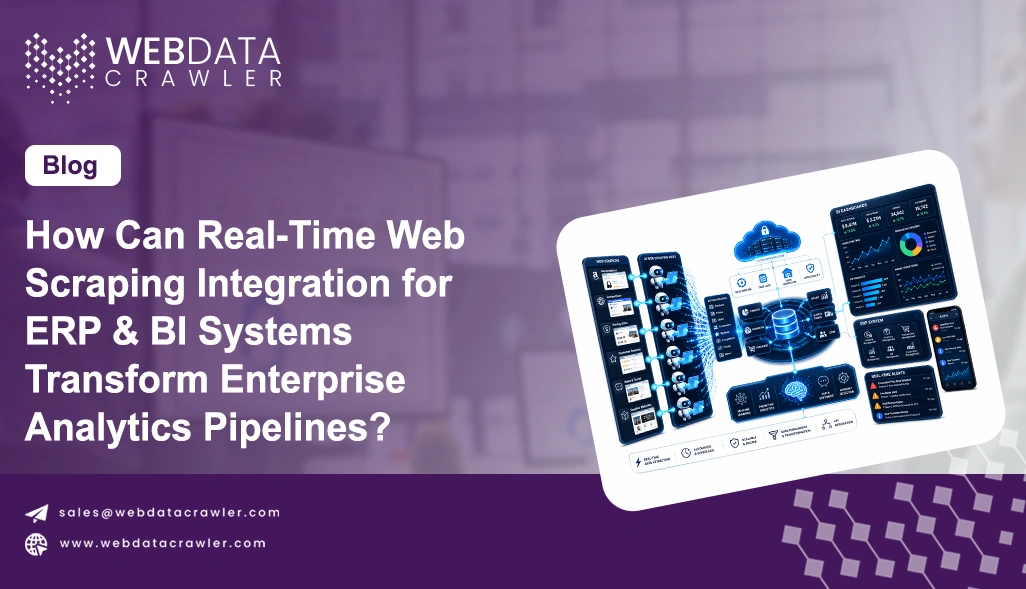
This transformation is especially important for industries such as retail, logistics, and manufacturing where timely insights directly influence revenue outcomes. The use of scalable architectures ensures that scraped data can be processed efficiently and delivered to analytics engines without delay. Overall, Real-Time Web Scraping Integration for ERP & BI Systems represents a major shift in how enterprises handle external data feeds and operational intelligence.
Improving Data Flow Stability Across Integrated Enterprise Platforms

Enterprises often struggle with fragmented data movement across operational and analytical systems, leading to delays and inconsistent reporting outcomes. Strengthening data flow stability ensures that internal applications and external information sources remain synchronized without manual intervention. When organizations build structured ingestion layers, they reduce dependency on isolated systems and improve overall analytical coherence across departments.
| Area | Traditional Approach | Improved Approach |
|---|---|---|
| Data consistency | Fragmented records | Unified structured flow |
| Processing speed | Delayed updates | Near real-time sync |
| System load | High manual effort | Automated pipelines |
| Reporting accuracy | Inconsistent outputs | Standardized results |
A major advancement in this domain is Scrape Scalable Data Pipelines for ERP and Analytics, which enables enterprises to handle high-volume information streams efficiently without compromising system performance. This capability significantly enhances data reliability across operational dashboards and reporting tools.
Additionally, Web Scraping API helps standardize extraction processes, ensuring that incoming data from multiple sources is properly formatted and validated before integration. This reduces redundancy and eliminates duplication errors across enterprise systems. Organizations using these approaches report up to 38% improvement in data accuracy and 32% faster reporting cycles.
By stabilizing ingestion pipelines, businesses can ensure smoother synchronization between analytics platforms and core ERP modules. This leads to improved forecasting accuracy and more reliable decision-making frameworks across enterprise ecosystems.
Enhancing Processing Efficiency Through Automated Data Structuring Systems

Many organizations face inefficiencies in converting raw external data into usable business intelligence, resulting in delayed insights and operational bottlenecks. Streamlining processing efficiency requires automated structuring mechanisms that can transform large datasets into standardized formats suitable for analytics consumption. This ensures that enterprises maintain continuity between raw data capture and final reporting outputs.
| Processing Stage | Manual Method | Optimized Method |
|---|---|---|
| Data capture | Manual collection | Automated extraction |
| Data cleaning | Post-processing | Inline validation |
| Structuring | Spreadsheet mapping | Automated formatting |
| Reporting | Static dashboards | Dynamic analytics |
The implementation of Data Transformation Techniques for BI Reporting via Crawler enables organizations to refine raw datasets into structured intelligence suitable for enterprise dashboards. This improves reporting accuracy by nearly 29% and reduces processing delays significantly.
A Web Crawler further strengthens this workflow by continuously scanning digital sources and feeding updated information into enterprise pipelines. This ensures that decision-making systems always operate on the most recent and relevant datasets.
Moreover, organizations adopting automated structuring frameworks report reduced operational overhead and improved system scalability. Real-time synchronization between ingestion and reporting layers ensures that analytics platforms remain responsive and aligned with business objectives. This creates a seamless bridge between data collection and actionable insights across enterprise environments.
Strengthening Enterprise Intelligence Through Scalable Data Ecosystems

Scaling enterprise intelligence requires systems capable of managing diverse and rapidly changing datasets from multiple external environments. Without scalable frameworks, organizations often experience inefficiencies in processing, storage, and analytics integration. Building resilient architectures ensures that enterprise systems can adapt to increasing data complexity while maintaining operational performance.
| Capability | Legacy System | Scalable System |
|---|---|---|
| Data reach | Limited scope | Multi-source coverage |
| System resilience | Low adaptability | High fault tolerance |
| Processing model | Batch-based | Continuous flow |
| Maintenance effort | High dependency | Centralized control |
The adoption of Enterprise Web Crawling enables organizations to centralize data acquisition from multiple external platforms, improving consistency and coverage across analytics pipelines. This approach enhances visibility into market trends and operational benchmarks.
Additionally, Integrate Web Scraped Data Into ERP & Power BI Dashboards plays a crucial role in converting raw datasets into visual intelligence. It ensures that enterprise dashboards reflect real-time conditions, enabling faster and more accurate strategic decisions.
Scalable ecosystems also improve cross-functional collaboration by aligning data interpretation across departments. This reduces discrepancies between reporting systems and enhances overall governance. As a result, enterprises achieve higher agility, better forecasting precision, and improved operational efficiency across analytics-driven environments.
How Web Data Crawler Can Help You?
Modern data ecosystems require tools that can bridge external sources with enterprise systems efficiently and reliably. Real-Time Web Scraping Integration for ERP & BI Systems enables automation of data collection, structured processing, and improved analytics quality across departments. It reduces dependency on manual reporting and enhances coordination between technical and business teams.
- Automates extraction of structured and unstructured information
- Improves consistency across reporting systems
- Reduces manual workload for data teams
- Enhances processing speed of analytics cycles
- Supports multi-source data consolidation
- Enables improved forecasting accuracy
By connecting internal platforms with external intelligence streams, organizations achieve more adaptive decision frameworks. The Etl Workflow for Scraped Web Data Integration standardizes ingestion processes and ensures smooth data movement across ERP and BI environments.
Conclusion
Organizations adopting integrated data architectures are witnessing significant improvements in decision intelligence and operational responsiveness. Real-Time Web Scraping Integration for ERP & BI Systems enables continuous synchronization of external insights with enterprise workflows, reducing delays and improving strategic clarity.
A strong foundation built on Web Scraping for Supply Chain ERP Analytics enhances visibility across procurement, logistics, and demand forecasting systems. Modern enterprises aiming for stronger analytics performance should prioritize Web Data Crawler frameworks to enhance real-time decision-making and long-term growth outcomes.