
How Does Proxy Rotation for Large-Scale Web Scraping Improve Stability Across Dynamic Websites?
July 9 2026
Introduction
Dynamic websites frequently adjust page structures, request limits, session behavior, and access controls to manage traffic. These changes create operational challenges for teams collecting public web data at scale, especially when repeated requests originate from the same network identity. A dependable proxy framework helps distribute requests intelligently, maintain continuity, and reduce interruptions during high-volume extraction workflows.
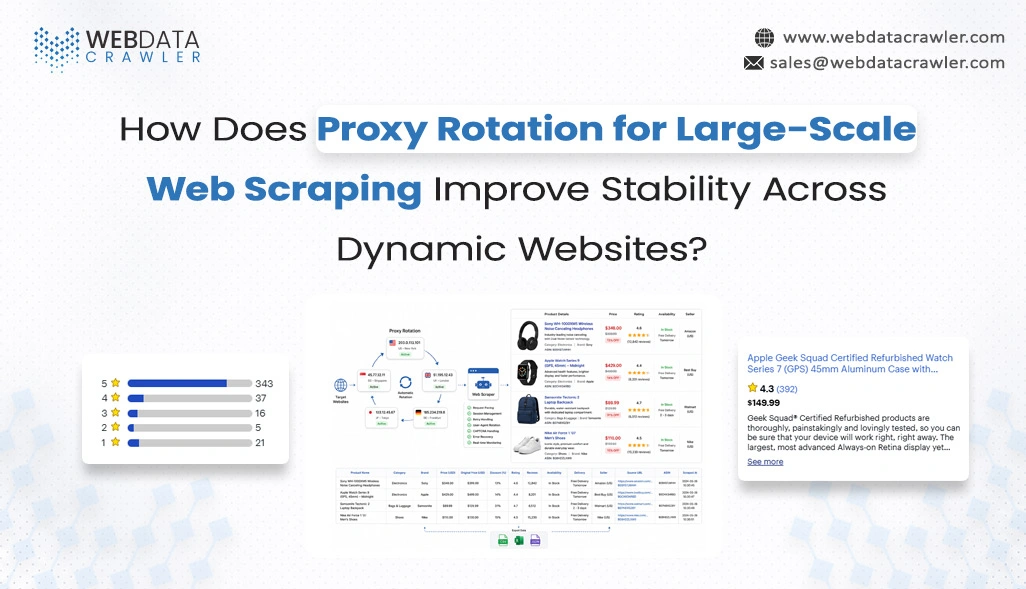
For data teams, Proxy Rotation for Large-Scale Web Scraping supports a more balanced approach to accessing changing websites. Instead of relying on a limited set of IPs, rotation systems assign different identities based on target rules, request frequency, geographic requirements, and session duration. This process helps crawlers continue gathering structured information without placing excessive pressure on a single endpoint.
This makes proxy management an important part of modern Enterprise Web Crawling operations. From product pricing and travel listings to marketplace inventory and public reviews, stable access supports better decision-making. When proxy rotation is combined with request pacing, browser simulation, retry handling, and monitoring, businesses can build more reliable data pipelines across websites that change frequently.
Balancing Request Volume Across High Traffic Website Environments

Large-scale data collection often encounters access restrictions when repeated requests originate from the same network source. Dynamic platforms monitor traffic frequency, request patterns, headers, and browsing behavior to identify unusual activity. When a crawler exceeds acceptable limits, websites may return CAPTCHAs, blocked pages, delayed responses, or incomplete content.
A controlled rotation framework distributes requests across suitable network identities and helps maintain a more natural access pattern. In the middle of high-volume workflows, Rotating IP Addresses Using Proxy for Web Scraping supports request distribution without overloading a single source. This approach can improve page retrieval consistency, particularly for catalog pages, listings, reviews, and publicly available product records.
For websites that rely heavily on JavaScript, cookies, and browser interactions, a Browser Data Crawler can manage rendered content, scrolling actions, headers, and session behavior more effectively. It helps teams capture information that may not appear in standard HTML responses.
| Collection Challenge | Operational Impact | Recommended Response |
|---|---|---|
| Frequent requests from one source | Temporary blocks or throttling | Distribute requests through controlled routing |
| CAPTCHA interruptions | Missing or delayed records | Detect challenge pages and apply retry rules |
| Strict request limits | Slower extraction cycles | Set pacing and concurrency thresholds |
| Session failures | Incomplete page sequences | Maintain target-specific session settings |
| Regional restrictions | Limited market visibility | Use location-based network coverage |
With response monitoring and structured retries, teams can reduce failed requests, maintain steadier crawl activity, and improve the completion rate of recurring data collection projects.
Managing Changing Content Across Interactive Digital Platform Experiences

Dynamic websites frequently modify their page layouts, content-loading methods, search filters, and visitor experiences. Pricing, inventory, travel availability, reviews, and promotional listings may change according to user location, device type, browsing session, or time of access.
Automation frameworks help manage these changes by coordinating page requests, retry attempts, validation rules, and structured exports. During complex extraction workflows, Web Scraping Automation With Python can support queue management, error handling, browser controls, and data formatting.
Some research requirements involve sensitive or difficult-to-access sources that demand stronger technical controls. In such cases, Deep and Dark Web Scraping Services can support monitored routing, secure collection processes, and carefully managed data-handling practices. These workflows require additional attention because source reliability, page structures, and access conditions may vary considerably.
| Dynamic Content Factor | Data Collection Difficulty | Practical Workflow Approach |
|---|---|---|
| JavaScript-rendered pages | Content appears after interaction | Use browser rendering and wait conditions |
| Personalized search results | Different users receive different records | Control cookies and session settings |
| Location-based listings | Regional information varies | Apply relevant geographic routing |
| Frequent layout updates | Selectors may fail unexpectedly | Use adaptable extraction logic |
| Infinite scrolling interfaces | Records load gradually | Automate scrolling and pagination |
A centralized Scraping Proxy API for Web Scraping can also simplify network allocation by assigning suitable routes based on response behavior, target sensitivity, geographic needs, and session requirements.
Building Scalable Systems Through Adaptive Network Management Practices

Growing data requirements often involve millions of records, recurring schedules, multiple regions, and diverse website categories. Without defined routing policies, collection systems may experience rising costs, inconsistent response quality, duplicate records, and frequent manual intervention.
For high-volume projects, Proxy Rotation Strategies for Enterprise Web Crawling can help teams determine when to change identities, preserve sessions, switch locations, or replace unreliable routes. Rotation frequency should depend on page sensitivity, expected request volume, content type, and whether a continuous browsing session is necessary.
Businesses requiring continuous updates can use Live Crawler Services to monitor page changes, refresh records, validate outputs, and identify unavailable sources across scheduled collection cycles. Meanwhile, IP Address Rotation for Scraping helps distribute traffic while supporting fallback actions when response quality declines.
| Rotation Approach | Suitable Scenario | Operational Benefit |
|---|---|---|
| Per-request routing | Public listing pages | Limits repetitive traffic patterns |
| Session-based routing | Multi-step website journeys | Maintains browsing continuity |
| Timed routing changes | Long-running collection tasks | Supports controlled distribution |
| Geographic routing | Regional market comparisons | Captures localized information |
| Failure-triggered routing | Restricted or unstable targets | Replaces weak network paths |
Public listing pages and large product catalogs may benefit from faster routing changes. In these workflows, Datacenter Proxy Rotation for Web Scraping can provide efficient response speeds for recurring monitoring, broad catalog tracking, and publicly accessible directory collection.
How Web Data Crawler Can Help You?
Reliable web data collection requires more than sending requests through multiple IPs. We build structured workflows that combine Proxy Rotation for Large-Scale Web Scraping with monitoring, validation, scheduling, and custom extraction logic.
Our solutions can support your data operations through:
- Target-specific crawling configurations
- Scheduled collection for recurring updates
- Geographic data coverage for regional analysis
- Automated retries and response validation
- Structured exports for analytics systems
- Continuous monitoring for data quality
After the collection workflow is configured, our team can apply Scraping Proxy API for Web Scraping capabilities to support flexible routing, controlled request distribution, and scalable extraction performance across multiple target platforms.
Conclusion
Stable web extraction depends on balancing speed, access quality, and response behavior across every target website. When implemented with monitoring and adaptive rules, Proxy Rotation for Large-Scale Web Scraping helps reduce failed requests, maintain broader access, and improve the reliability of ongoing data pipelines.
Businesses can strengthen collection performance by using IP Address Rotation for Scraping alongside browser automation, validation checks, and target-specific request controls. Contact Web Data Crawler today to build a dependable scraping workflow designed for your data requirements.