
How Product Matching Across Retailers Using Algorithms & Practices Solves Complex Data Challenges?
May 05
Introduction
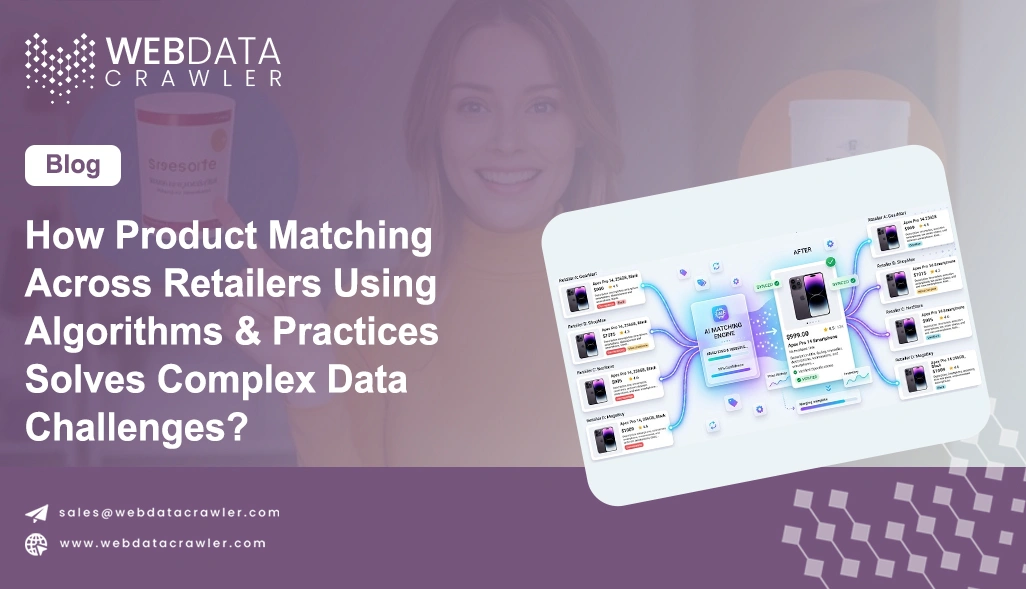
In today's fast-evolving eCommerce ecosystem, aligning product data across multiple retailers is no longer a simple task. Businesses often deal with inconsistent naming conventions, missing identifiers, and varying product attributes that create serious data fragmentation. This is where Product Matching Across Retailers Using Algorithms & Practices becomes essential for maintaining catalog consistency and enabling smarter decisions.
One of the major advantages of streamlined product matching is its role in Competitive Benchmarking, where businesses evaluate their market position against competitors. Retailers often struggle with duplicate listings, incorrect product groupings, and mismatched variants, all of which reduce data accuracy and operational efficiency.
Modern approaches rely on intelligent algorithms such as machine learning models, similarity scoring, and rule-based systems to bridge these gaps. As digital shelves continue to expand, the need for scalable and accurate product alignment is more critical than ever for driving growth and maintaining a competitive edge in the market.
Managing Data Variations Across Multiple Retail Sources Effectively
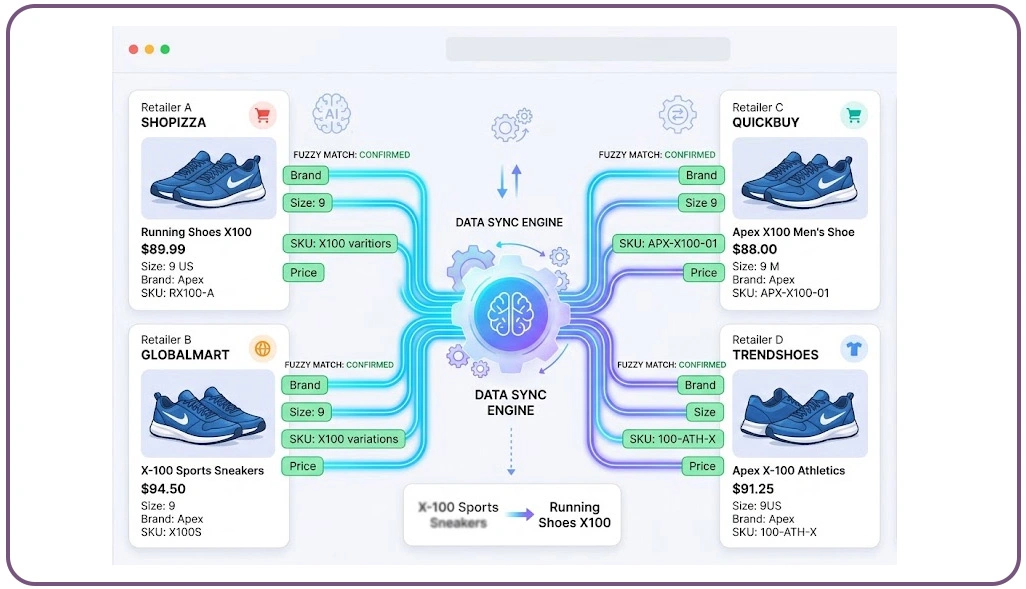
Retailers frequently encounter inconsistent product data when sourcing from multiple platforms, creating challenges in maintaining a unified catalog. Differences in naming conventions, descriptions, and formatting often lead to duplicate or mismatched entries. To address this issue, advanced techniques such as Fuzzy Matching Product Names Using Web Scraping help identify similar products even when naming structures differ significantly.
Alongside this, implementing Best Practices for Retail Product Catalog Matching ensures that attributes like brand, size, and specifications are standardized across datasets. These practices reduce ambiguity and improve the reliability of catalog structures. Another important component is pricing alignment. By using Extracting Price Comparison for Product Matching, businesses can compare identical products across retailers and maintain pricing consistency.
Additionally, Competitor Price Monitoring allows organizations to track pricing trends and make informed adjustments to remain competitive in dynamic markets. These combined strategies create a strong foundation for accurate product mapping. Industry studies suggest that nearly 30% of product listings across marketplaces suffer from inconsistencies, which directly impacts revenue and operational clarity.
| Challenge | Solution Approach | Impact |
|---|---|---|
| Inconsistent naming formats | Fuzzy matching techniques | Higher matching accuracy |
| Duplicate product listings | Data normalization practices | Reduced redundancy |
| Pricing inconsistencies | Price comparison extraction | Better pricing decisions |
By integrating structured practices with intelligent matching methods, retailers can significantly improve data consistency and operational efficiency.
Addressing Missing Identifiers And Filling Product Data Gaps
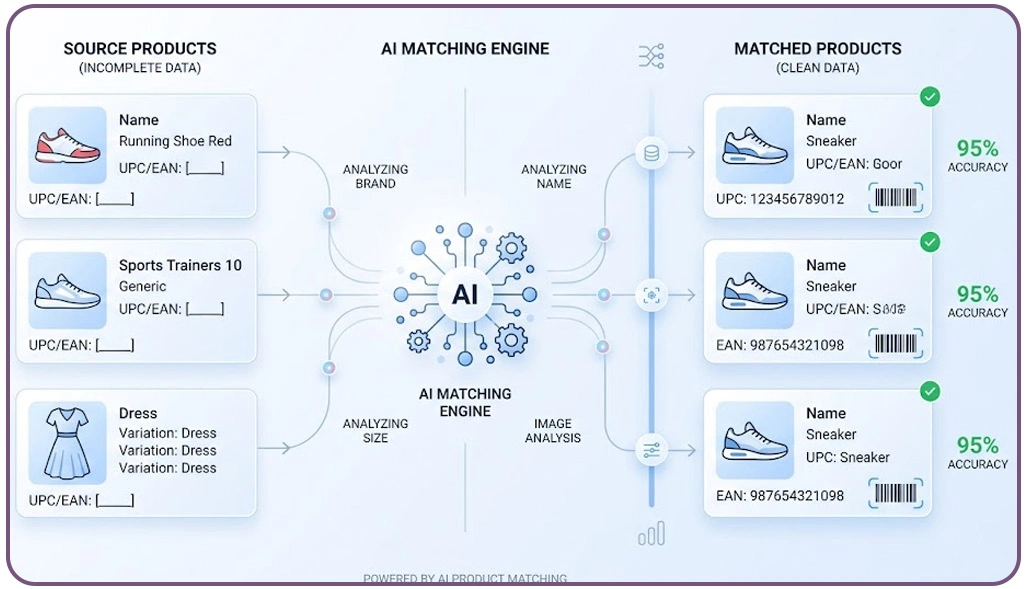
One of the most significant challenges in product matching is the absence of universal identifiers such as UPC or EAN codes. Without these identifiers, direct mapping becomes complex and often unreliable. This raises an important question for businesses: How to Match Products Without a Common Identifier? The solution lies in combining multiple product attributes such as brand name, specifications, and textual similarity to create accurate matches.
When identifiers are available, Barcode Matching Across Retailers via Web Crawler becomes a highly effective method. It ensures precise alignment by linking products through unique barcodes, significantly improving accuracy rates. Research indicates that barcode-based matching can achieve up to 95% precision, making it a reliable approach for large datasets.
Furthermore, UPC-Based Product Matching for Retail Data Integration enables businesses to scale their operations efficiently. It supports seamless integration of data from multiple sources while maintaining consistency across platforms.
| Data Issue | Matching Technique | Result |
|---|---|---|
| Missing identifiers | Attribute-based matching | Flexible data alignment |
| Incomplete product details | Multi-attribute comparison | Improved data completeness |
| Availability of barcodes | Barcode-driven matching | High precision mapping |
By combining attribute-based strategies with identifier-driven methods, businesses can effectively bridge data gaps and ensure reliable product matching across diverse retail environments.
Enhancing Scalability Through Automation And Intelligent Systems
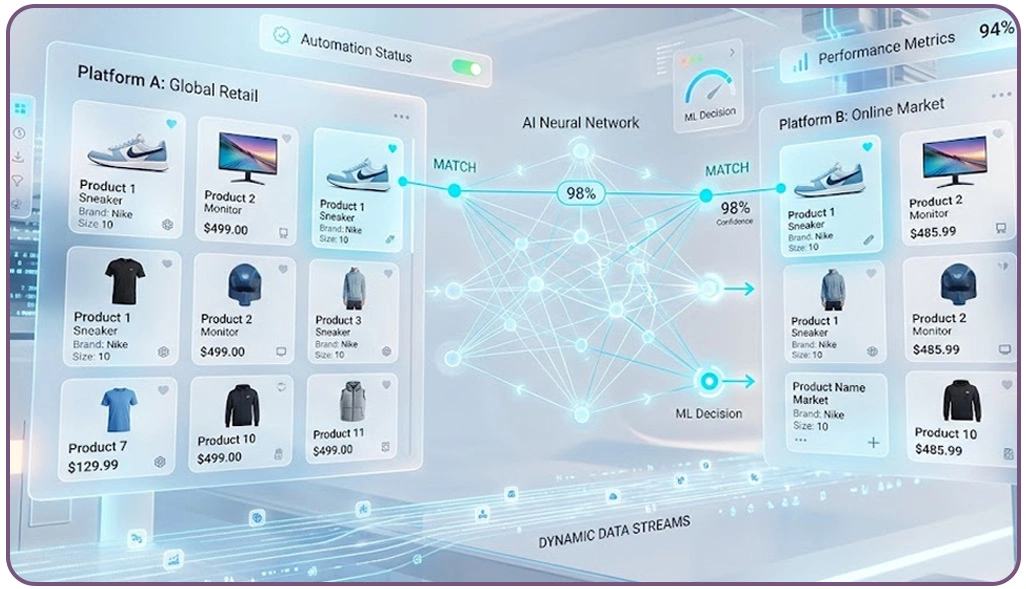
As retail catalogs continue to grow, manual product matching becomes inefficient and time-consuming. Automation plays a crucial role in handling large-scale datasets while maintaining accuracy. Modern systems integrate AI-driven models with tools like Scraping API to collect, process, and update product data in real time. This ensures that product matching remains consistent even as catalogs evolve.
Automated systems significantly improve processing speed, allowing businesses to handle millions of product records with minimal manual intervention. Over time, machine learning models refine their accuracy by learning from previous matching patterns, making them more effective with continuous use. This adaptability is essential in dynamic retail environments where product information frequently changes.
Additionally, automation supports seamless integration across multiple platforms, enabling consistent data flow between marketplaces, websites, and applications. This flexibility ensures that businesses can maintain a unified product view across all channels.
| Scaling Factor | Automated Solution | Benefit |
|---|---|---|
| Large product datasets | AI-driven matching models | Faster processing |
| Frequent data updates | Real-time data extraction systems | Accurate information |
| Multi-channel integration | API-based workflows | Seamless synchronization |
By adopting automation and intelligent systems, organizations can scale their product matching processes efficiently while ensuring high accuracy and operational consistency.
How Web Data Crawler Can Help You?
Modern retail businesses require precision and scalability to manage complex datasets effectively. With Product Matching Across Retailers Using Algorithms & Practices, we provide advanced solutions that streamline product alignment across multiple platforms.
Our approach includes:
- Improve product data consistency across multiple sources.
- Reduce duplication and mismatched listings.
- Enable real-time updates for dynamic catalogs.
- Enhance pricing accuracy and comparison capabilities.
- Support scalable data processing for large inventories.
- Deliver actionable insights for better business decisions.
In addition, our expertise in Barcode Matching Across Retailers via Web Crawler ensures precise identification and alignment of products, even in complex datasets.
Conclusion
Accurate product alignment is no longer optional in modern retail environments. By adopting Product Matching Across Retailers Using Algorithms & Practices, organizations can create a unified view of their products and make data-driven decisions with confidence.
At the same time, implementing techniques like Fuzzy Matching Product Names Using Web Scraping ensures flexibility in handling inconsistent data and missing identifiers. Now is the time to take action and transform your data processes with Web Data Crawler expert-driven solutions.