
Sharper Product Intelligence with Mercado Libre E-Commerce Dataset for AI and Machine Learning
02 September 2026
Introduction
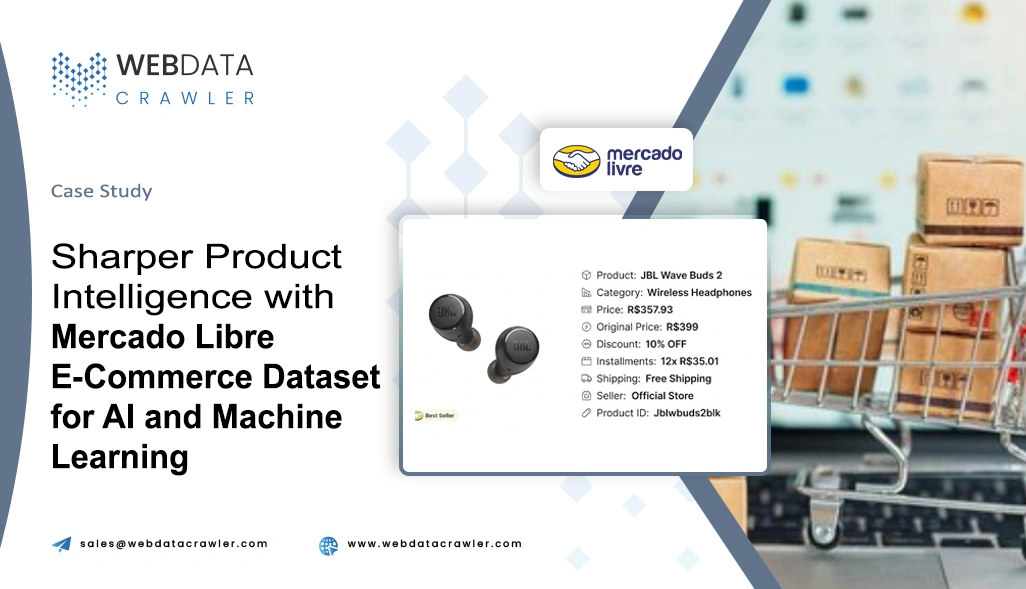
Latin America's e-commerce landscape has grown exponentially over the past decade, and Mercado Libre stands at its center as the region's most dominant digital marketplace. For businesses competing in this environment, raw intuition is no longer sufficient. This case study explores how a technology-driven retail analytics firm harnessed the Mercado Libre E-Commerce Dataset for AI and Machine Learning to overcome deep-rooted data quality and accessibility challenges.
The client needed a scalable mechanism to Scrape MercadoLibre Product Data across thousands of categories and millions of SKUs to feed downstream machine learning pipelines. Without reliable, clean, and consistently structured datasets, their AI models produced unreliable outputs that weakened forecasting and recommendation performance.
We stepped in with a tailored data acquisition framework that fundamentally upgraded how the client sourced, processed, and operationalized marketplace intelligence. By deploying our purpose-built extraction infrastructure, the client gained a consistent flow of structured records from Mercado Libre, transforming their data maturity and giving their AI teams the fuel required to build models that perform at scale across multiple Latin American markets.
Client Success Story
Our client is a mid-sized AI product company specializing in pricing intelligence tools and demand forecasting platforms for retail brands operating across Latin America. Founded over a decade ago, the company serves a portfolio of over eighty brand clients across Brazil, Argentina, Mexico, Colombia, and Chile. Their internal data science teams had built sophisticated model architectures but were consistently bottlenecked by one persistent problem: poor-quality training data.
The company had experimented with various data vendors but found that most offered either incomplete coverage or inconsistently formatted records. Their need for a comprehensive Mercado Libre E-Commerce Dataset for AI and Machine Learning was driven by the sheer scale and diversity of products listed on the platform, which no off-the-shelf solution could adequately address.
They also required a granular Mercado Libre SKU Dataset for Argentina to serve a key client in the consumer electronics segment who demanded hyper-local pricing accuracy. The operations team described the situation as one of data hunger, where models were ready to learn but the structured input they required simply wasn't available in a reliable, repeatable form. We were brought in to architect and deliver that missing data layer.
The Core Challenges

The client encountered a distinct set of technical and operational obstacles that prevented them from building dependable AI training pipelines from Mercado Libre data.
- Authentication and Anti-Scraping Architecture
Mercado Libre employs sophisticated request validation, CAPTCHA systems, and behavioral analytics to detect and block automated data access. Building compliant and resilient pipelines to collect E-Commerce Datasets at the volume required without disruption demanded specialized infrastructure that the client lacked internally.
- Structural Inconsistency Across Categories
Product listings across different verticals on Mercado Libre vary significantly in their attribute completeness and formatting conventions. Normalizing these records into a unified schema suitable for model training was technically demanding and labor-intensive without purpose-built transformation logic.
- Geographic and Currency Variation Complexity
Collecting the Mercado Libre Marketplace Dataset for Analysis in a way that preserved regional context while enabling cross-market comparison required careful architectural planning that existing tools couldn't provide out of the box.
— Main Client Requirement —
Beyond resolving individual technical friction points, the client's primary requirement was a single, unified data pipeline capable of delivering clean, refreshed, and well-structured Mercado Libre product records on a continuous basis, directly integrated into their existing model training environments without requiring heavy internal data engineering overhead.
Smart Solution
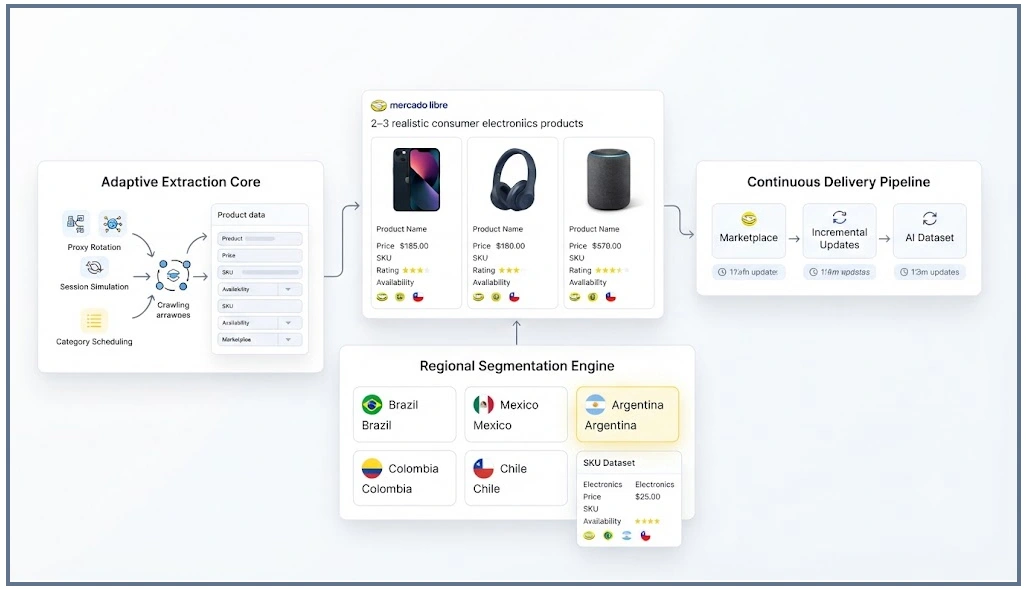
After evaluating the client's technical ecosystem, AI workflow requirements, and regional coverage needs, we designed a multi-layered data acquisition and processing solution calibrated specifically to Mercado Libre's infrastructure.
- Adaptive Extraction Core
We deployed a dynamic crawling engine that uses rotating proxy pools, behavioral session simulation, and category-aware request scheduling to reliably collect Mercado Libre Dataset Scraping for AI workflows.
- Regional Segmentation Engine
We built market-specific data channels for Brazil, Mexico, Argentina, Colombia, and Chile. The Mercado Libre SKU Dataset for Argentina feed was given a dedicated refresh cadence to meet the consumer electronics client's pricing sensitivity requirements.
- Continuous Delivery Pipeline
A scheduled refresh architecture was implemented to maintain data freshness across all markets. Incremental update logic minimized redundant extraction while ensuring the client's training datasets reflected current marketplace conditions at every model retraining cycle.
Execution Strategy
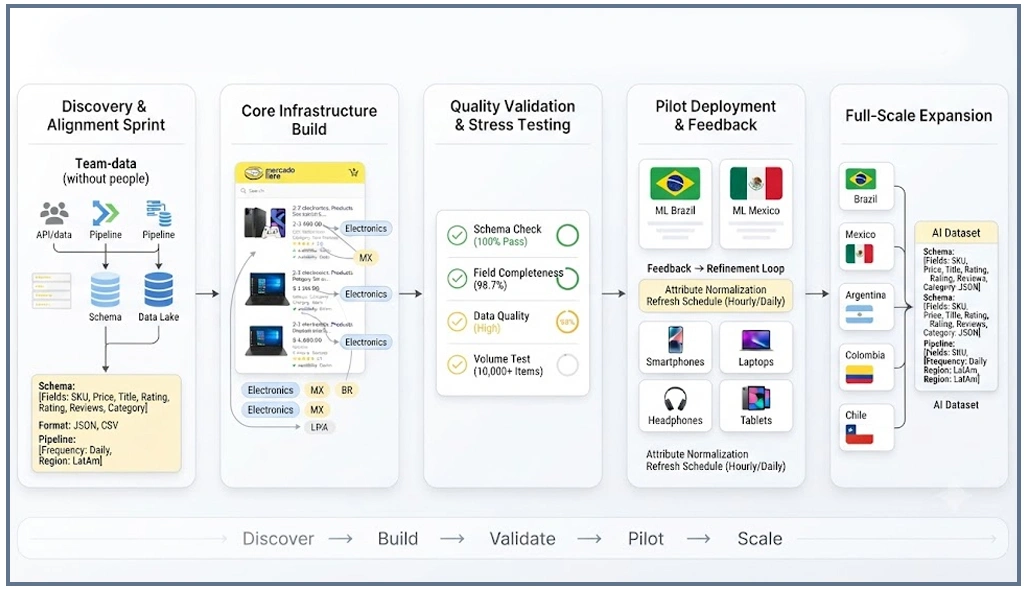
We followed a phased deployment methodology designed to minimize disruption, validate system stability, and scale efficiently across the client's multi-market AI infrastructure.
- Discovery and Alignment Sprint
We conducted deep technical sessions with the client's data engineering and ML teams to map their pipeline requirements, define schema standards, and align delivery formats with existing data lake infrastructure. This phase produced a shared deployment specification document used throughout the engagement.
- Core Infrastructure Build
Our engineers built the extraction and transformation infrastructure against Mercado Libre's live environment, incorporating all category-specific logic and regional segmentation requirements. This phase included hardening the system against common detection triggers and validating output quality across a representative cross-section of categories.
- Quality Validation and Stress Testing
Using Web Scraping Ecommerce Data protocols, we executed comprehensive validation routines, including schema compliance checks, field completeness audits, and volume stress tests under peak marketplace activity conditions. This phase confirmed that delivery quality would meet the client's model training standards consistently.
- Pilot Deployment and Feedback Integration
Initial deployment focused on two markets and four product categories identified as highest priority by the client. Feedback from the data science team was incorporated iteratively, resulting in refinements to attribute normalization logic and refresh scheduling before full-scale rollout.
- Full-Scale Expansion
Following successful pilot validation, the solution was expanded to all five target markets and the full product category scope. Staff briefings ensured the client's internal teams understood data structure conventions and could integrate new feeds independently into their workflows.
Impact & Results
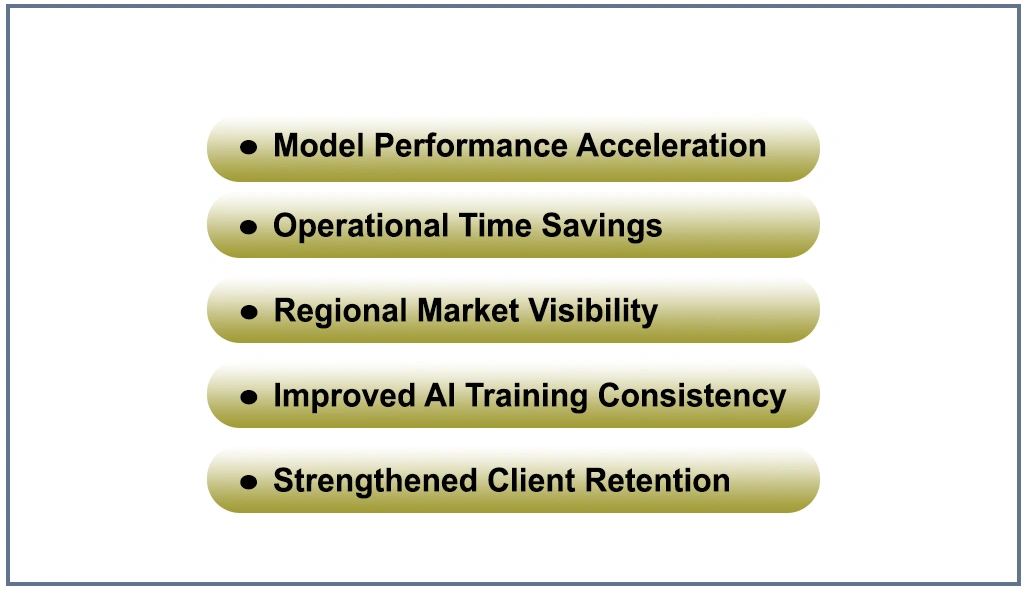
The deployment of our extraction platform produced significant and measurable improvements across the client's AI model performance, operational efficiency, and market intelligence capabilities.
- Model Performance Acceleration
With a consistently clean Mercado Libre AI Training Dataset flowing into their pipelines, the client's pricing models achieved a 38% improvement in prediction accuracy, while recommendation engine performance increased by 31% within the first quarter of full operation.
- Operational Time Savings
Data preparation and preprocessing time, previously a major bottleneck in the client's ML workflow, dropped by 44%. Engineers previously spending hours reformatting and cleaning marketplace records could redirect their capacity toward model development and feature engineering.
- Regional Market Visibility
The client gained granular visibility into pricing movements and product availability across all five Latin American markets. The Mercado Libre Marketplace Dataset for Analysis capability enabled their brand clients to identify competitive gaps and respond to pricing shifts within hours rather than days.
- Improved AI Training Consistency
Freshness guarantees delivered by the continuous refresh pipeline eliminated model degradation caused by stale training data. The client's retraining cycles became more reliable and predictable, improving the stability of model deployments across their customer base.
- Strengthened Client Retention
Backed by richer, more current data insights, the client's brand customers reported higher satisfaction with the intelligence platform outputs, directly contributing to a 19% improvement in annual contract renewal rates.
Final Takeaways
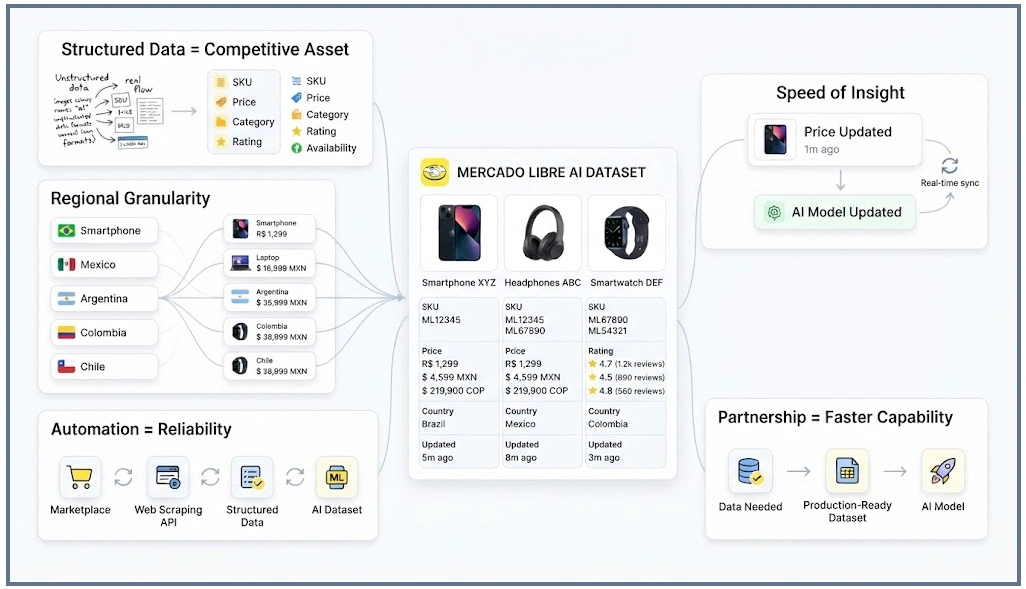
This engagement reinforces several strategic principles that apply broadly to organizations building AI capabilities on top of marketplace data.
- Structured Data Is a Competitive Asset
The quality of a machine learning model is fundamentally capped by the quality of its training data. Organizations that invest in properly structured, continuously refreshed Mercado Libre Dataset Scraping for AI pipelines create a durable foundation for model performance that competitors relying on lower-quality inputs cannot match.
- Regional Granularity Unlocks Localized Intelligence
Treating Latin America as a monolithic market produces blunt insights. Preserving country-level context within a unified dataset architecture allows AI models to learn regionally specific patterns, dramatically improving the relevance of forecasting and recommendation outputs for local operators.
- Automation Replaces Fragility With Reliability
Manual or semi-automated data collection introduces variability that degrades model training over time. Replacing fragile processes with a Web Scraping API-powered delivery architecture removes human bottlenecks and ensures that data quality is maintained as a system property rather than an operational responsibility.
- Speed of Insight Determines Strategic Responsiveness
Markets move quickly. The gap between a pricing shift on Mercado Libre and an AI model's awareness of that shift directly determines how effectively a business can respond. Minimizing that gap through real-time or near-real-time data refresh transforms intelligence from a historical record into an active competitive tool.
- Partnership Accelerates Capability Development
Building sophisticated data extraction infrastructure internally requires significant time and specialized expertise. Partnering with a dedicated provider like us allows organizations to access production-ready capabilities immediately, compressing the timeline from data needed to model-ready dataset by months.

Working with Web Data Crawler redefined what we thought was possible with our AI training pipelines. The Mercado Libre E-Commerce Dataset for AI and Machine Learning they delivered was exactly what our data science team needed; clean, consistent, and refreshed on a schedule that matched our retraining cycles. Our Mercado Libre AI Training Dataset feeds now power our most accurate models to date, and the impact on our client satisfaction scores has been remarkable. This was a genuinely transformative data partnership.
— Head of Data Infrastructure, AI Retail Intelligence Platform
Conclusion
For AI and machine learning teams building on Latin American marketplace data, the path to model reliability runs directly through data quality. The Mercado Libre E-Commerce Dataset for AI and Machine Learning we delivered gave the client's teams a foundation they could build on with confidence.
Through targeted Mercado Libre Marketplace Dataset for Analysis capabilities, the client's brand partners gained regional pricing intelligence they had never accessed before. Contact Web Data Crawler today to discuss your data acquisition needs. Our Mercado Libre SKU Dataset for Argentina and broader Latin American coverage options can be scoped and deployed rapidly to match your timeline and technical requirements.