
Retail Brand Improved Margins With Grocery Competitor Price Tracking Using Web Scraping Solutions
May 28
Introduction
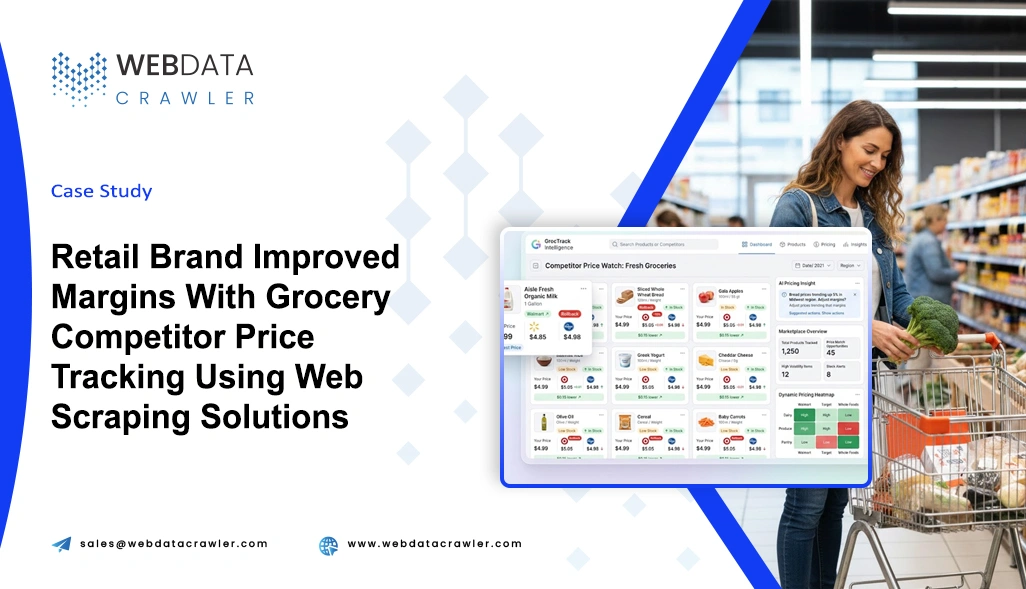
The grocery retail sector is one of the most pricing-sensitive markets in the world, where even fractional differences in product costs can shift customer loyalty overnight. This case study details how a prominent retail brand transformed its competitive positioning through Grocery Competitor Price Tracking Using Web Scraping overcoming complex data barriers to build a smarter, faster intelligence ecosystem.
The client needed more than periodic snapshots of competitor catalogs. They required a fully automated intelligence pipeline capable of capturing real-time price movements, promotional shifts, and category-level patterns across dozens of rival storefronts. With the support of our Live Crawler Services, we built a system that converted raw competitor data into boardroom-ready insights directly influencing pricing decisions, promotional calendars, and category planning for the months ahead.
Using AI-Based Grocery Price Intelligence Solutions, the platform did not merely collect data but interpreted it flagging anomalies, predicting discount cycles, and surfacing margin-risk zones before they impacted sales. The client moved from reactive firefighting to proactive strategy, achieving measurable financial outcomes within the first two quarters of deployment.
Client Success Story
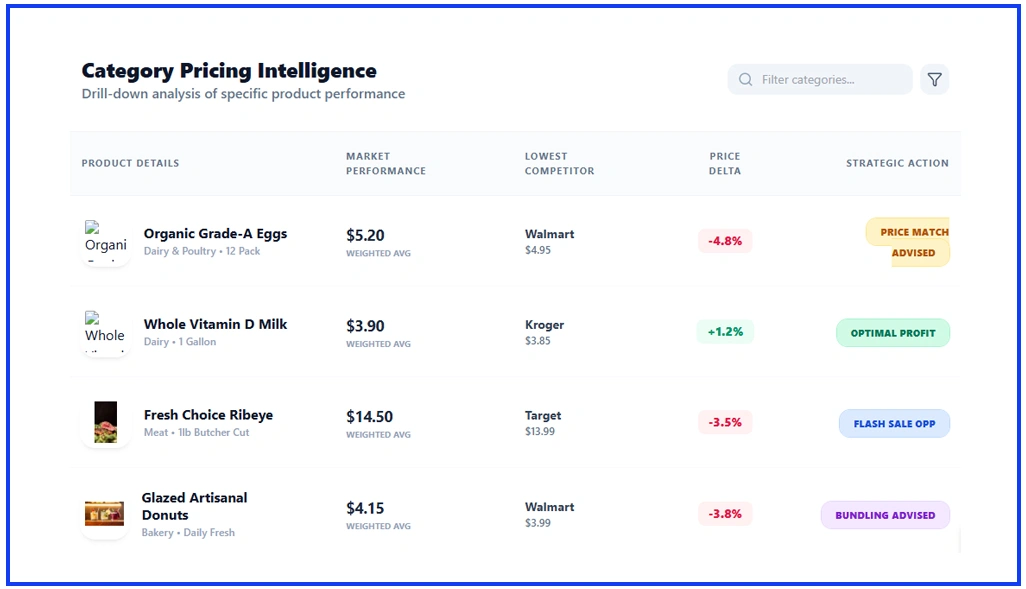
Our client is an established mid-to-large retail brand operating across eleven cities, with both physical store networks and a growing e-commerce presence on major online grocery platforms. Having served shoppers across fresh produce, packaged goods, and household essentials for over a decade, the brand held a loyal customer base but found that loyalty increasingly vulnerable to aggressive competitor discounting.
Their category managers were spending disproportionate hours manually browsing rival websites and apps to gauge price positioning, a process that was unreliable, inconsistent, and far too slow for a market where prices changed multiple times a week. Without a structured approach to Grocery Competitor Price Tracking Using Web Scraping, the team was consistently making pricing decisions based on outdated assumptions rather than live market realities.
The brand's leadership recognized that sustainable margin improvement required a shift in how competitive intelligence was gathered, processed, and acted upon. They approached Web Data Crawler with a clear mandate: replace guesswork with data, and manual effort with automation.
Within six months of deploying our solution, the client recorded:
- 31% improvement in gross margin across tracked product categories
- 27% faster pricing decision cycles across category teams
- 34% reduction in time spent on manual competitive research
- 23% uplift in promotional campaign accuracy
The Core Challenges
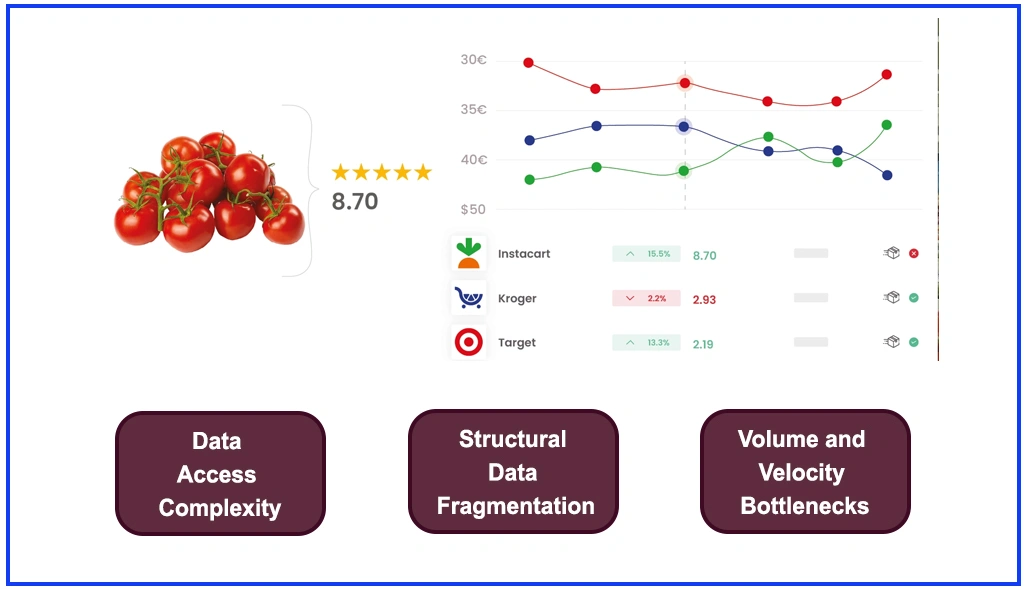
The path from manual research to automated intelligence was not without friction. Several structural and technical obstacles stood between the client and the competitive clarity they needed.
-
Data Access Complexity
Establishing a reliable pipeline for Grocery Data Extraction for Competitive Analysis required navigating these defenses without disrupting the client's operational continuity or risking access interruptions.
-
Structural Data Fragmentation
Consolidating this fragmented information into a clean, comparable dataset demanded robust normalization logic and a classification framework capable of handling thousands of SKU variations simultaneously.
-
Volume and Velocity Bottlenecks
The client's competitor landscape included over forty active retailers, each carrying thousands of products. Without scalable tools to Leverage Online Grocery Stores Data Scraping to Optimize Pricing and Discounts, the sheer data throughput would have overwhelmed any conventional analytics setup.
– Main Client Requirement –
Beyond solving the immediate data access and processing challenges, the client's core
requirement was clear: they needed a unified intelligence platform that could ingest,
clean, and visualize competitor pricing data daily and integrate seamlessly with their
internal pricing and merchandising workflows, without requiring significant changes to
their existing technology stack.
Smart Solution
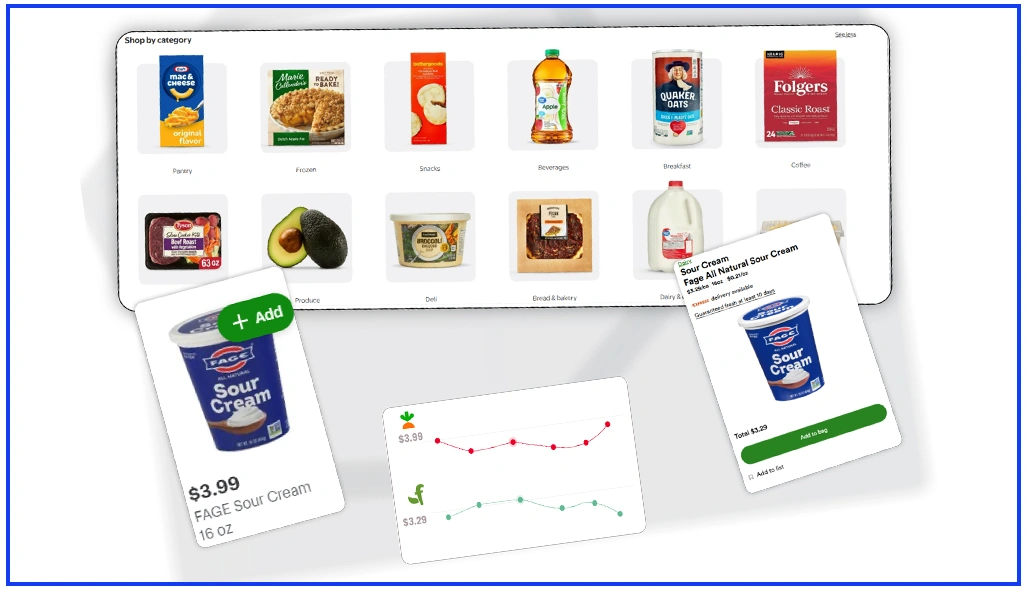
After an in-depth discovery phase covering the client's category structure, technology environment, and competitive landscape, we engineered a three-component solution designed specifically for high-volume grocery intelligence operations.
-
PriceLens Competitive Engine
The system supported Real-Time Grocery Price Monitoring Solutions by capturing price changes, promotional activations, and stock-level shifts within defined refresh cycles, giving category managers a live view of the competitive landscape rather than a delayed one.
-
DataBridge Normalization Layer
This enabled direct apples-to-apples comparisons that were previously impossible with manual methods. Grocery Data Extraction for Competitive Analysis became not just a data task but an ongoing analytical function embedded in the client's daily operations.
-
InsightGrid Analytics Dashboard
The system leveraged Retail Grocery Intelligence Software via Crawler capabilities to deliver automated alerts when competitor prices crossed pre-set thresholds, weekly trend digests sent directly to relevant stakeholders, and a historical pricing archive that revealed seasonal discount cycles across competitor catalogs.
Execution Strategy
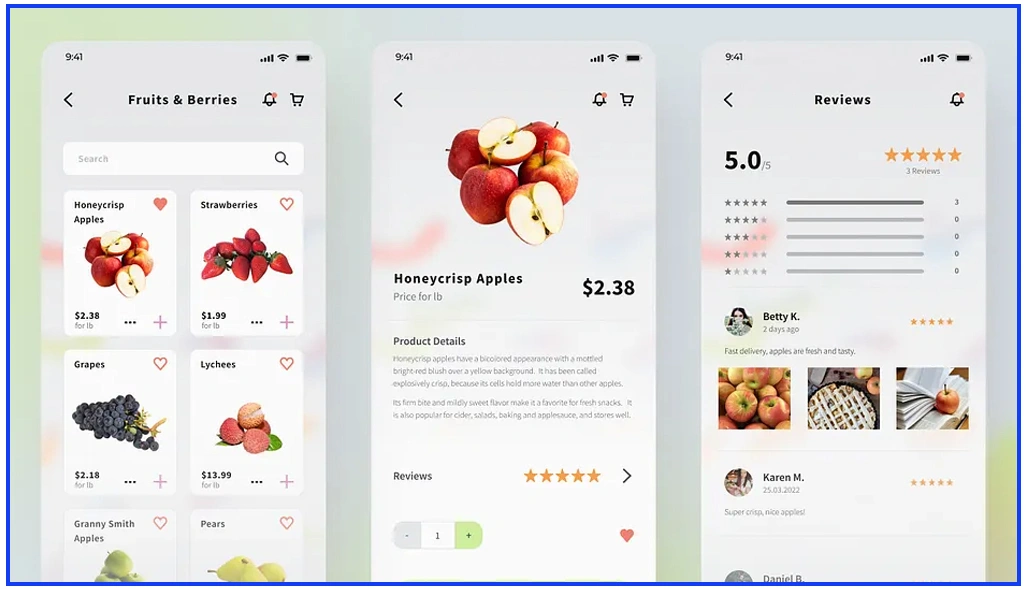
Delivering a solution of this complexity required a carefully sequenced rollout that minimized disruption while building toward full-scale operation.
-
Discovery and Architecture Alignment
This phase established the scope of the crawler network, defined success benchmarks across accuracy, freshness, and coverage metrics, and produced a deployment plan that fit around the client's fiscal calendar.
-
Infrastructure Build and Crawler Calibration
The Review Scraping Services framework was applied here validating extraction accuracy across price fields, promotional tags, and product identifiers before any data entered the client's pipeline.
-
Integration Testing and Stability Validation
Before full activation, the combined system underwent extensive load testing to confirm performance during high-traffic crawl windows including the Friday-weekend period when competitor promotions peaked.
-
Staged Market Rollout
During this phase, category managers received onboarding sessions covering dashboard navigation, alert configuration, and report interpretation. Performance feedback from this cohort was used to refine crawler scheduling and improve dashboard filtering before the broader rollout.
-
Full-Scale Expansion and Continuous Improvement
A feedback loop between the client's category teams and our technical team ensured that new competitor sources could be added within days, and that evolving platform structures on competitor sites were addressed through regular crawler maintenance cycles.
Impact & Results
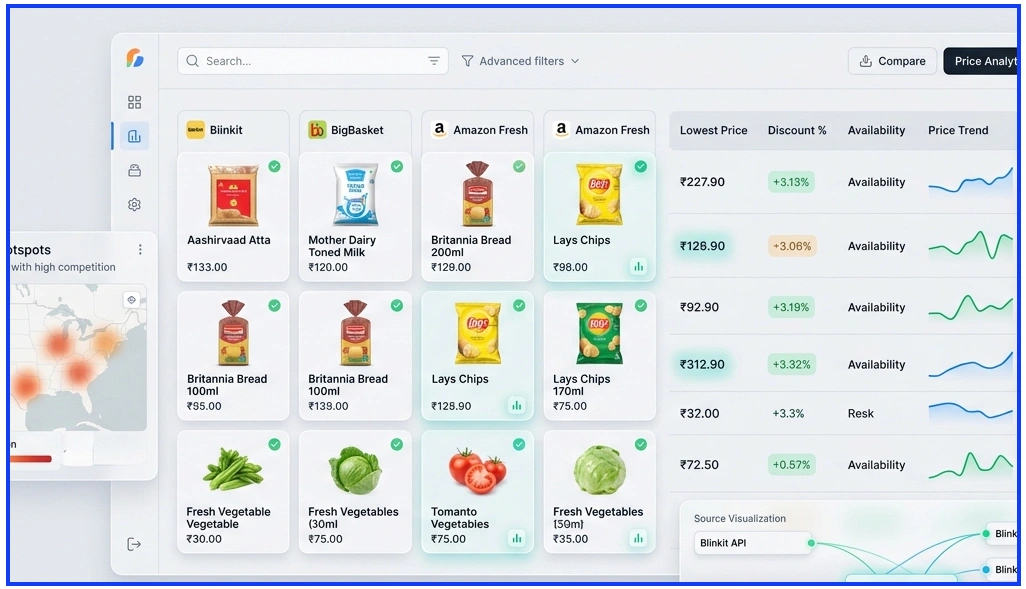
The deployment delivered quantifiable results across multiple strategic dimensions, confirming the value of a structured, automated approach to competitive intelligence.
-
Margin Recovery and Pricing Precision
Equally, they found segments where over-aggressive pricing was suppressing conversion. Grocery Competitor Price Tracking Using Web Scraping gave them the evidence base to recalibrate both ends of the pricing spectrum, driving a sustained improvement in category-level gross margins.
-
Faster Competitive Response
With live monitoring in place, Real-Time Grocery Price Monitoring Solutions compressed that response window to under 24 hours, allowing pricing updates to be reviewed, approved, and published before meaningful basket share was lost.
-
Promotional Intelligence Uplift
The historical pricing archive revealed patterns that were invisible at the operational level, recurring discount windows tied to competitor fiscal quarters, category-specific promotional cycles, and bundle structures consistently used by the top three rivals.
-
Reduced Research Overhead
Category managers who had previously spent a combined 120+ hours per month on manual price checks redirected that capacity toward analysis and strategy. The automation layer did not merely collect data faster; it freed human attention for higher-order tasks that required judgment rather than repetition.
-
Strategic Positioning Reinforcement
Grocery Market Trend Analysis Using Scraped Data provided the macro-level view to identify emerging competitor positioning strategies and category expansion moves weeks before they became apparent to shoppers, enabling a genuinely proactive competitive stance.
Final Takeaways
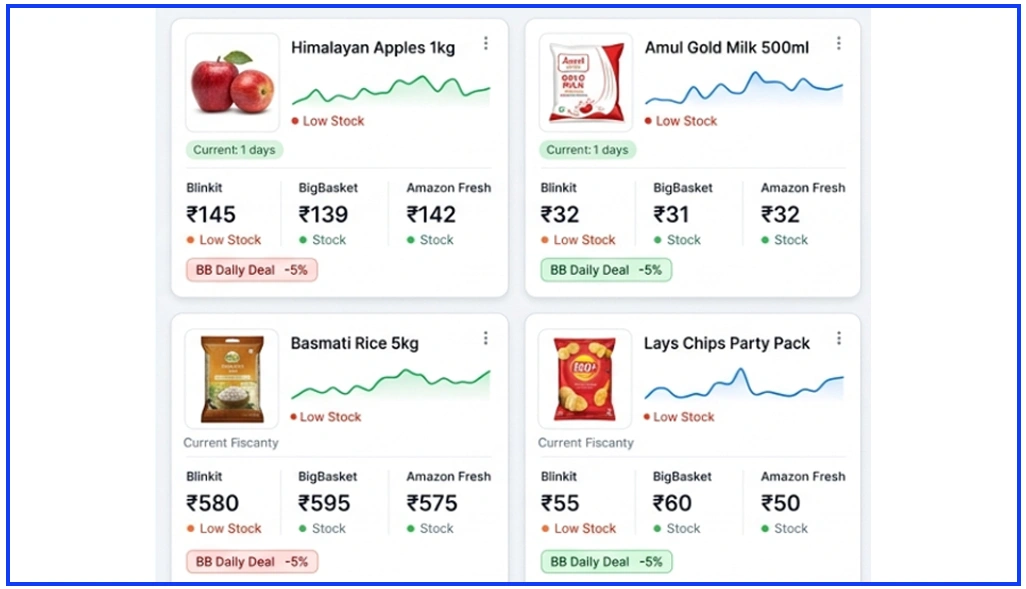
This engagement produced several transferable insights for retail brands navigating similar competitive intelligence challenges.
-
Precision Over Volume
The most impactful improvement came not from adding more data sources, but from ensuring every source delivered accurate, structured, comparable output for Grocery Market Trend Analysis Using Scraped Data that teams could act on without manual intervention.
-
Speed Is a Strategic Asset
In grocery retail, pricing windows are short. A Pricing Intelligence system that delivers yesterday's data is only marginally better than no system at all. The client's most significant operational improvement came from compressing the gap between competitor action and internal awareness.
-
Integration Determines Adoption
Embedding competitive intelligence directly into the category managers' daily routines through dashboard alerts, digest emails, and integration with their planning tools was what converted data access into behavioral change and, ultimately, measurable outcomes.
-
Continuous Coverage Requires Continuous Maintenance
The client's ongoing competitive advantage depends on a crawling infrastructure that adapts continuously, not a one-time build. Regular crawler maintenance, source expansion, and coverage audits are what keep the intelligence pipeline delivering reliable output over time.
-
Data-Backed Culture Compounds Returns
AI-Based Grocery Price Intelligence Solutions did not just solve the immediate problem; they rewired how the organization thought about market information, creating a compounding capability advantage that grew stronger each quarter.
Client's Testimonial

"Web Data Crawler completely changed how our category teams approach pricing. Before this, we were working with incomplete pictures of the market and losing margin as a result. The platform's approach to Grocery Competitor Price Tracking Using Web Scraping gave us the structured, reliable intelligence we needed to price with confidence. AI-Based Grocery Price Intelligence Solutions made what felt like a complex challenge into a repeatable, scalable process."
– Head of Category Management, National Retail Brand
Conclusion
The competitive grocery landscape leaves no room for pricing decisions made on incomplete information. This engagement demonstrated how a structured, technology-driven approach to Grocery Competitor Price Tracking Using Web Scraping can translate directly into margin recovery, operational efficiency, and a more confident strategic posture.
And with Grocery Data Extraction for Competitive Analysis embedded in daily workflows, the organization now treats competitive intelligence not as a periodic exercise but as a continuous operational input. Contact Web Data Crawler today to schedule a consultation with our grocery intelligence specialists.