


How Do Food Data Scraping API Services for Businesses Help Avoid Blocks and Keep Data Flowing?
Sep 16
Introduction
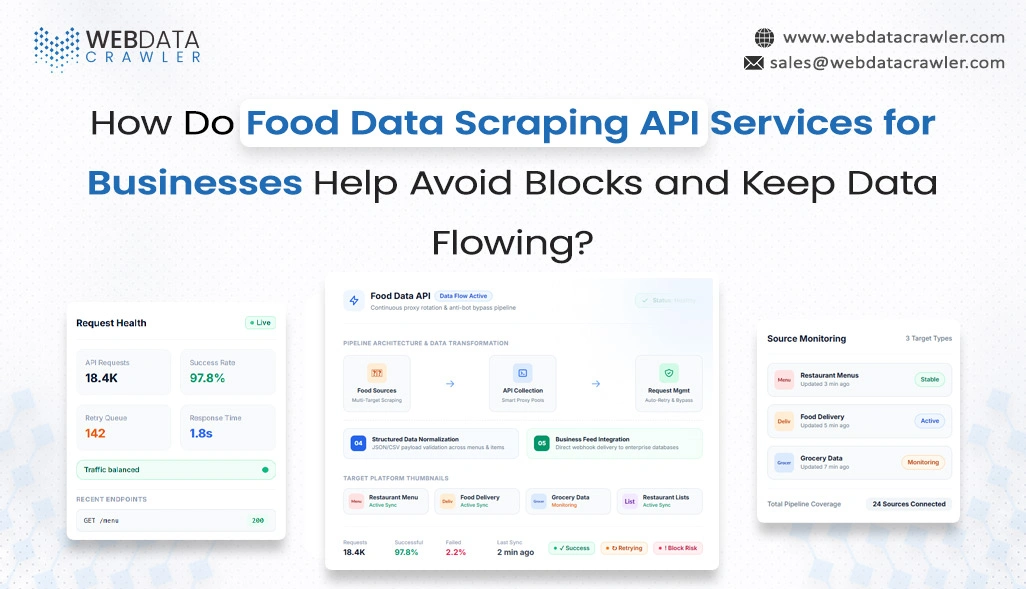
Food businesses increasingly depend on current pricing, availability, menus, ratings, and delivery information for informed decisions. Yet repeated automated requests can trigger rate limits, bot detection, or temporary restrictions. A reliable collection framework therefore needs more than extraction speed; it must manage request behavior, source changes, and data quality consistently.
Modern Food Data Scraping API Services for Businesses can support structured collection across food delivery platforms, grocery marketplaces, restaurant listings, and sources. When requests are routed thoughtfully, traffic is controlled, and extraction patterns vary responsibly, teams can reduce interruptions while maintaining a dependable stream of usable information for analytics and planning.
Effective scraping also depends on monitoring response patterns and adapting workflows before failures spread. Using Web Scraping Food Data with request pacing, rotating collection paths, validation checks, and retry controls can help businesses maintain continuity while reducing pressure on target websites and APIs. This supports cleaner datasets and stable analysis.
Building Stable Food Data Collection With Controlled Request Patterns
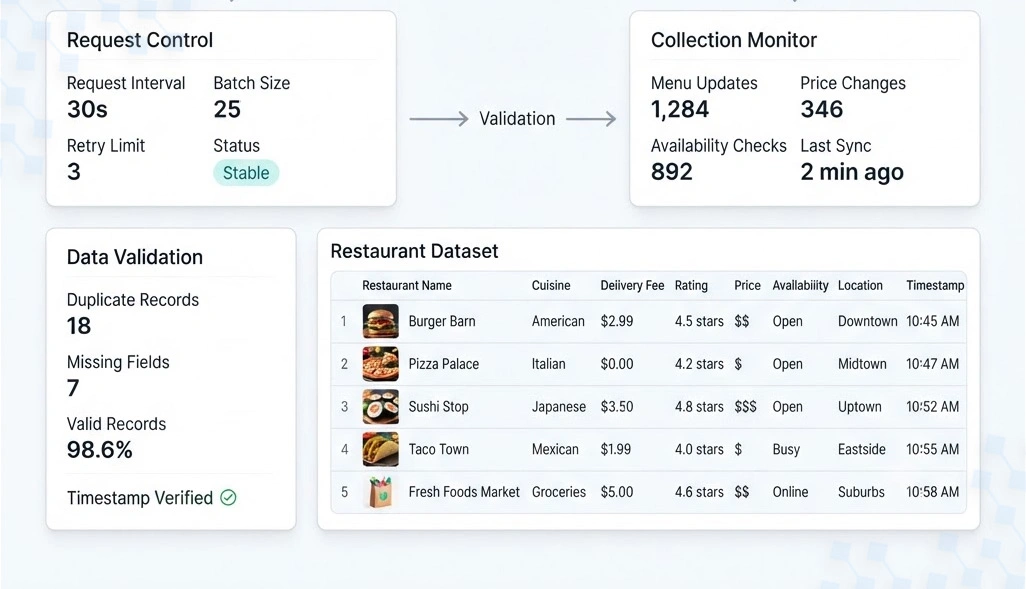
Food data collection becomes more reliable when businesses combine structured extraction with controlled request patterns. Delivery platforms, grocery marketplaces, and restaurant websites frequently update prices, menus, availability, ratings, and delivery details. A carefully planned workflow can collect these changes without creating unnecessary traffic spikes. During How to Scrape Food Delivery Data Without Getting Blocked, businesses can focus on request scheduling, appropriate intervals, retry handling, and response monitoring to keep collection processes consistent.
Data quality is equally important because large-scale extraction can produce duplicate, incomplete, or outdated records. Businesses can introduce validation rules that check important fields before information enters analytical databases. Food and Restaurant Datasets become considerably more useful when records are standardized, timestamps are preserved, and missing values are identified early. This allows teams to compare restaurants, products, prices, and availability across locations while reducing the amount of manual correction required after collection.
A dependable workflow can include several practical controls:
- Schedule requests at suitable intervals.
- Validate important fields before storage.
- Record timestamps for changing information.
- Detects duplicate and incomplete records.
- Monitor failed requests and unusual responses.
| Workflow Component | Primary Purpose | Business Value |
|---|---|---|
| Request Scheduling | Manage collection frequency | Greater consistency |
| Validation | Check incoming records | Improved accuracy |
| Monitoring | Identify workflow issues | Faster intervention |
| Storage | Maintain historical information | Easier comparisons |
Separating extraction, validation, storage, and analysis also improves long-term maintainability. When source structures change, businesses can update specific processing components rather than rebuilding the complete workflow.
Historical information can then support pricing comparisons, assortment tracking, restaurant benchmarking, and market research. This structured approach creates a stronger foundation for continuous collection while helping teams manage changing source conditions more efficiently.
Controlling Automated Requests To Maintain Reliable Data Access
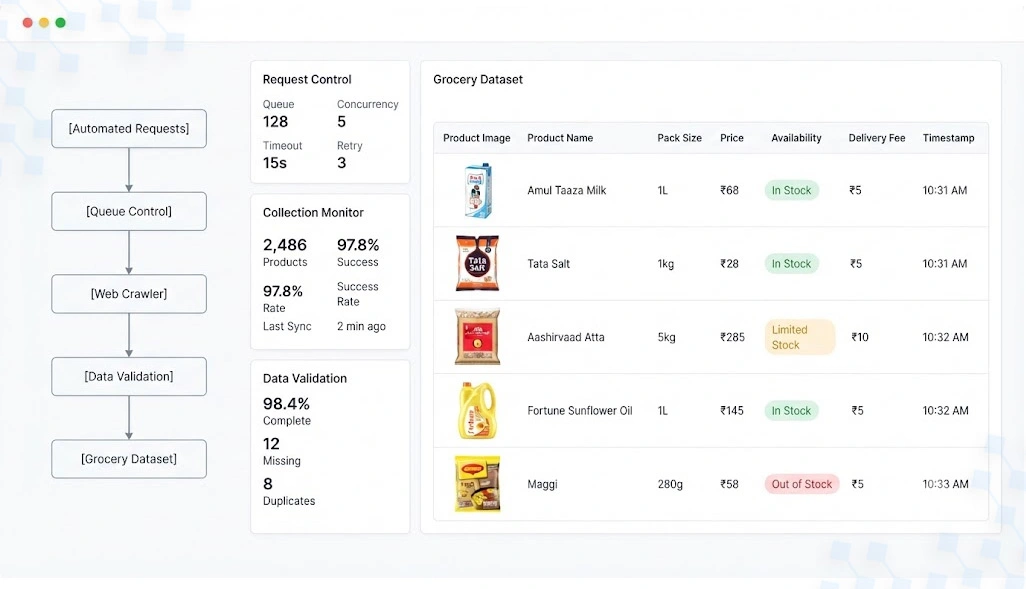
Automated collection can become unstable when large numbers of requests are generated within short periods. Businesses therefore need to manage request volume according to source behavior and collection requirements. Queue-based processing, controlled concurrency, suitable timeouts, and carefully configured retries can help prevent sudden traffic increases. While Extracting Grocery Delivery Data for Insights, these practices can support consistent collection of product prices, availability, delivery charges, categories, and other market information without creating unnecessary operational pressure.
Monitoring responses provides another layer of reliability. Changes in response status, missing fields, unexpected page structures, or declining success rates can indicate that a collection workflow needs attention. A Web Crawler can form part of a broader data pipeline, while validation mechanisms verify whether incoming records remain complete and usable. Early detection helps technical teams respond to collection problems before inaccurate or incomplete information reaches dashboards and analytical systems.
Businesses can strengthen request management through:
- Queue-based processing for large workloads.
- Appropriate timeout and retry configurations.
- Continuous response-status monitoring.
- Validation checks for incoming records.
- Detailed logs for troubleshooting purposes.
| Control Area | Monitoring Focus | Operational Benefit |
|---|---|---|
| Request Volume | Traffic distribution | Fewer sudden spikes |
| Response Status | Successful and failed requests | Faster issue identification |
| Data Quality | Missing or inconsistent fields | Cleaner datasets |
| Workflow Logs | Collection activity | Easier troubleshooting |
Request schedules should also remain flexible because source behavior and business requirements can change. A fixed configuration may become unsuitable when collection frequency increases or information is updated more often. Adaptive scheduling and controlled processing allow teams to adjust workflows according to actual requirements. This creates a more resilient environment for continuous food intelligence, particularly when information must be refreshed across multiple sources and locations.
Strengthening Food Data Pipelines Through Flexible Extraction Management
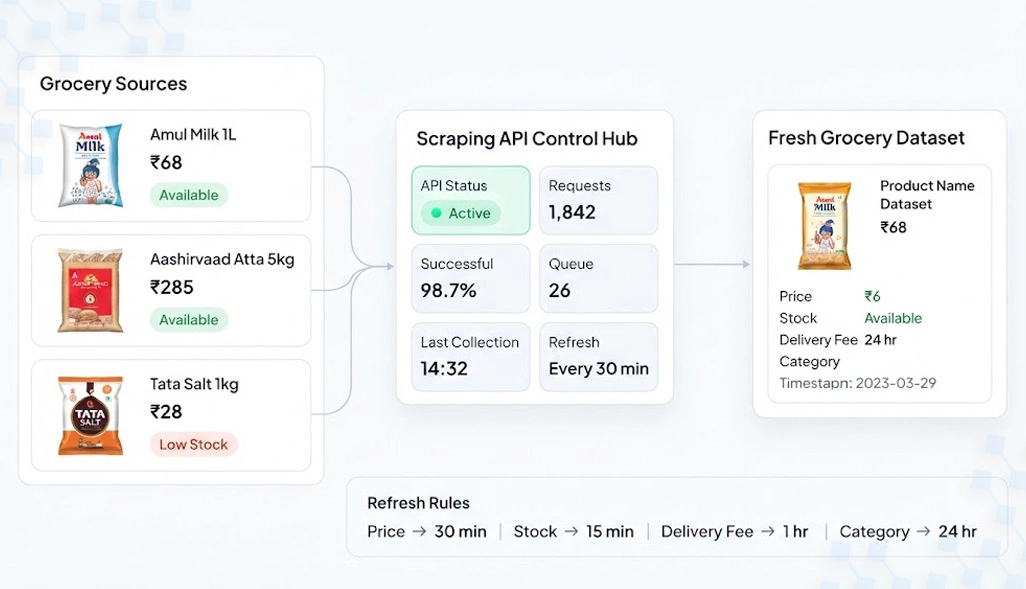
Reliable food data pipelines depend on coordination between extraction, validation, storage, and monitoring. Businesses may collect information from numerous platforms, each presenting different structures and update frequencies. A standardized pipeline can process incoming records through defined stages before they reach analytical systems. Grocery Delivery Data Scraping API for Analysis can support organized workflows where product details, pricing, availability, and category information need to be collected and processed consistently.
Freshness is especially important because food prices, promotions, inventory, delivery fees, and restaurant availability can change throughout the day. A Scraping API can support repeatable collection when connected with scheduling, validation, and storage mechanisms. Businesses can establish different refresh cycles according to how frequently specific fields change. Highly dynamic pricing information may require more frequent updates, while relatively stable information can follow longer collection intervals.
A strong pipeline can incorporate:
- Defined refresh schedules for changing information.
- Separate stages for extraction and validation.
- Historical records for trend comparisons.
- Automated monitoring of collection performance.
- Structured logs for completed and failed cycles.
| Pipeline Stage | Main Function | Result |
|---|---|---|
| Extraction | Gather source records | Updated information |
| Validation | Check data consistency | More reliable records |
| Storage | Preserve processed information | Historical accessibility |
| Monitoring | Review workflow health | Faster issue management |
Modular processing makes it easier to expand the workflow when businesses add new sources, fields, or analytical requirements. Historical storage can help identify pricing movements, assortment changes, availability patterns, and competitive developments across different periods.
By keeping each pipeline stage clearly defined, organizations can improve maintainability while reducing repetitive manual work. The result is a more dependable foundation for food-market analysis and recurring business intelligence.
How Web Data Crawler Can Help You?
A structured crawling solution can help businesses organize large-scale food information collection while keeping extraction workflows manageable. Food Data Scraping API Services for Businesses can be integrated with scheduled collection, validation, monitoring, and storage processes to create a consistent data pipeline. This approach helps teams reduce repetitive manual research and prepare information for pricing analysis, market comparisons, restaurant intelligence, and delivery trends.
A reliable workflow can support:
- Automated collection across selected food-data sources.
- Scheduled updates for frequently changing information.
- Structured storage for historical comparison.
- Validation of prices, menus, availability, and listings.
- Monitoring of collection performance and failed requests.
- Flexible processing for dashboards and analytical systems.
After collection and validation, teams can organize information according to business objectives and reporting requirements. Food Delivery Data Using Web Scraping can contribute to broader analysis when the collected records are properly structured and maintained. With appropriate scheduling, monitoring, and quality checks, businesses can establish a repeatable process that supports ongoing food-market research while reducing unnecessary interruptions in their data pipeline.
Conclusion
Reliable collection requires a balance between data freshness, request management, validation, and workflow monitoring. Food Data Scraping API Services for Businesses can provide a structured foundation for maintaining food pricing, product, restaurant, and delivery information while supporting consistent downstream analysis. A well-planned pipeline can also make ongoing updates easier to manage as sources and business requirements change.
For teams focused on dependable market intelligence, How to Scrape Food Delivery Data Without Getting Blocked provides an important direction for building responsible collection practices around scheduling, monitoring, and controlled requests. These measures can help maintain cleaner datasets and more stable workflows over time. Contact Web Data Crawler today to build a reliable food data collection solution tailored to your business requirements.