
Modern Crawling Solutions: Enterprise Web Crawling Architecture for Business Across Millions of URLs
20 August, 2026
Introduction
The digital commerce landscape has entered an era defined by data velocity and structural complexity. Organizations that once relied on manual research or periodic market audits are now racing to adopt automated intelligence systems capable of processing web data at massive scale. Businesses increasingly depend on Enterprise Web Crawling Architecture for Business to systematically navigate, extract, and structure web content across millions of URLs without operational disruption.
Modern enterprises are discovering that the sheer volume of publicly accessible data product listings, pricing updates, inventory signals, and consumer sentiment presents both an opportunity and a technical challenge. A well-designed Web Crawler enables organizations to collect this information continuously, feeding analytics pipelines that power pricing strategies, product discovery, and competitive intelligence in near real time.
Current industry benchmarks show that companies deploying structured crawling infrastructures report a 53% improvement in data freshness compared to those using periodic manual collection methods. This report investigates how modern crawling systems are reshaping enterprise data strategies, the architectural components driving scalability, and the measurable business outcomes associated with advanced web data collection across large-scale commercial environments.
Market Overview
The global enterprise web data extraction market is projected to surpass $19.8 billion by the end of 2025, expanding at a compound annual growth rate of 34.2% from 2022. This growth is fueled by the accelerating adoption of e-commerce platforms, the rise of dynamic web content, and growing organizational appetite for Large Scale Web Crawling for E Commerce capabilities that can keep pace with rapid catalog changes and competitive pricing shifts.
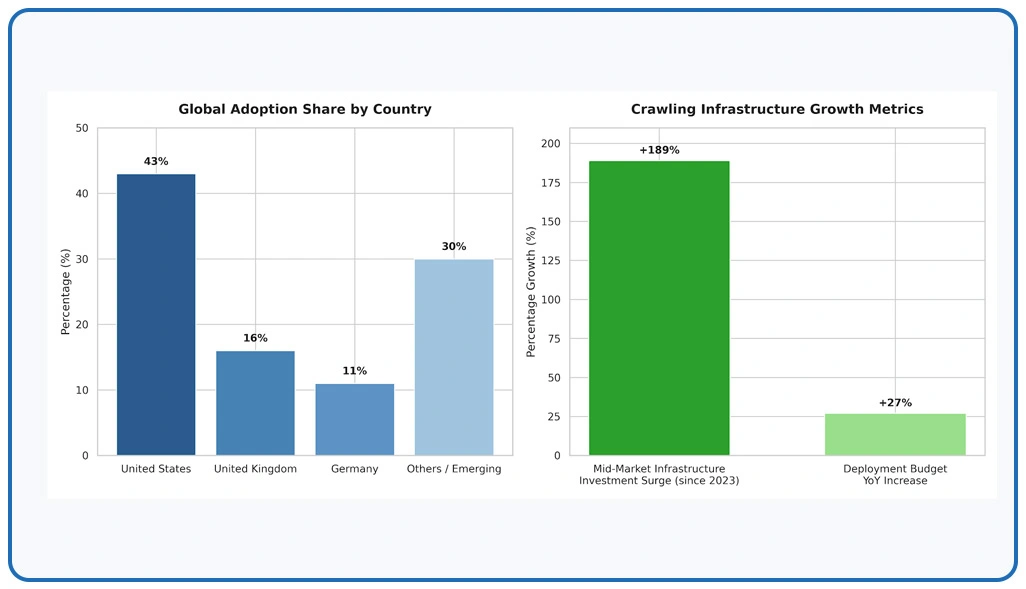
The United States accounts for approximately 43% of global adoption, followed by the United Kingdom at 16% and Germany at 11%. Emerging growth corridors in Southeast Asia and Latin America are also showing accelerated uptake, particularly in retail and logistics sectors.
Mid-market enterprises have driven a notable 189% surge in crawling infrastructure investments since 2023, narrowing the gap previously held by large enterprise players alone. The average deployment budget for scalable crawling systems increased by 27% year-over-year, reflecting growing confidence in ROI from structured web data programs.
Methodology
To build a rigorous foundation for this analysis, a multi-layered research framework was applied across diverse industry verticals and geographic markets:
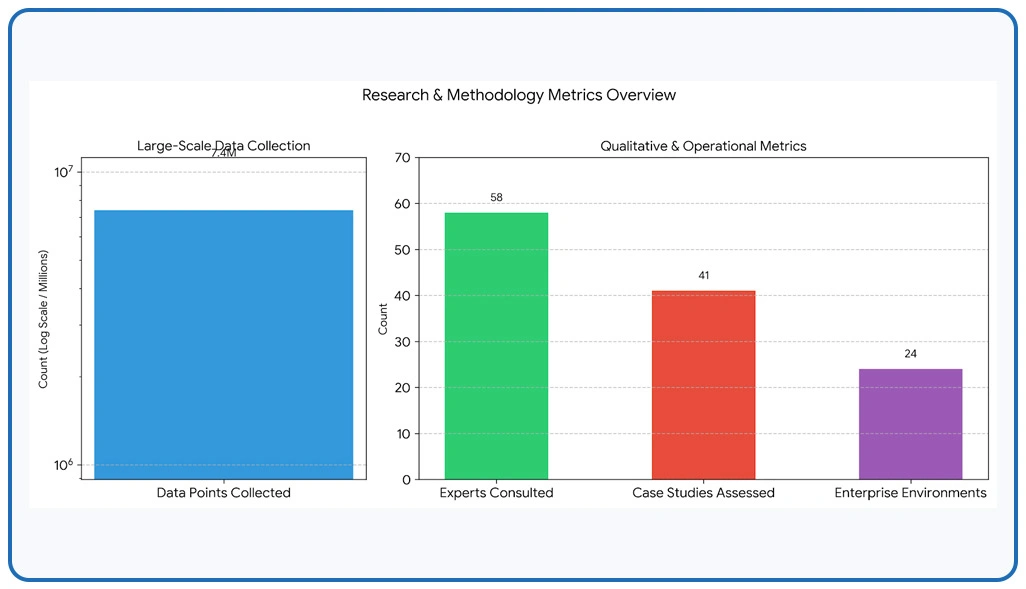
- Structured Data Collection: Over 7.4 million data points were gathered from e-commerce platforms, product databases, and public web repositories, utilizing Distributed Web Crawling Architecture for Web Scraping techniques to ensure broad and consistent coverage.
- Expert Consultation: In-depth interviews were conducted with 58 data engineering professionals and enterprise architects with direct experience implementing large-scale crawling systems.
- Case Study Evaluation: Forty-one deployment case studies were assessed across retail, logistics, financial services, and travel sectors to identify recurring patterns in successful infrastructure design.
- Performance Benchmarking: Crawling system performance metrics were tracked across 24 enterprise environments, using Live Crawler Services to measure throughput, data accuracy, and system resilience under high-volume conditions.
- Compliance and Risk Assessment: Legal and regulatory frameworks across key jurisdictions were reviewed to understand their implications for large-scale data collection programs.
Table 1: Enterprise Crawling Use Cases by Industry Vertical
| Industry | Adoption Rate | Avg. URLs Crawled Daily | Data Accuracy | Deployment Cost |
|---|---|---|---|---|
| E-Commerce Retail | 88% | 4.2M | 91% | $52K |
| Travel & Hospitality | 76% | 2.8M | 87% | $43K |
| Financial Services | 69% | 1.6M | 94% | $61K |
| Logistics & Supply Chain | 63% | 3.1M | 83% | $38K |
This table highlights how adoption rates and data processing demands vary significantly across industries. E-commerce leads in both volume and deployment scale, while financial services prioritizes precision over breadth. Cost differentials reflect infrastructure complexity rather than adoption maturity.
Key Findings
Data collected across enterprise deployments reveals a sharp upward curve in both adoption depth and technical sophistication. Organizations implementing Scalable Crawler Infrastructure for E Commerce Business Insights have reported a 71% increase in actionable data availability within the first six months of deployment. Retail sector implementations specifically noted a 143% improvement in price monitoring responsiveness compared to legacy methods.
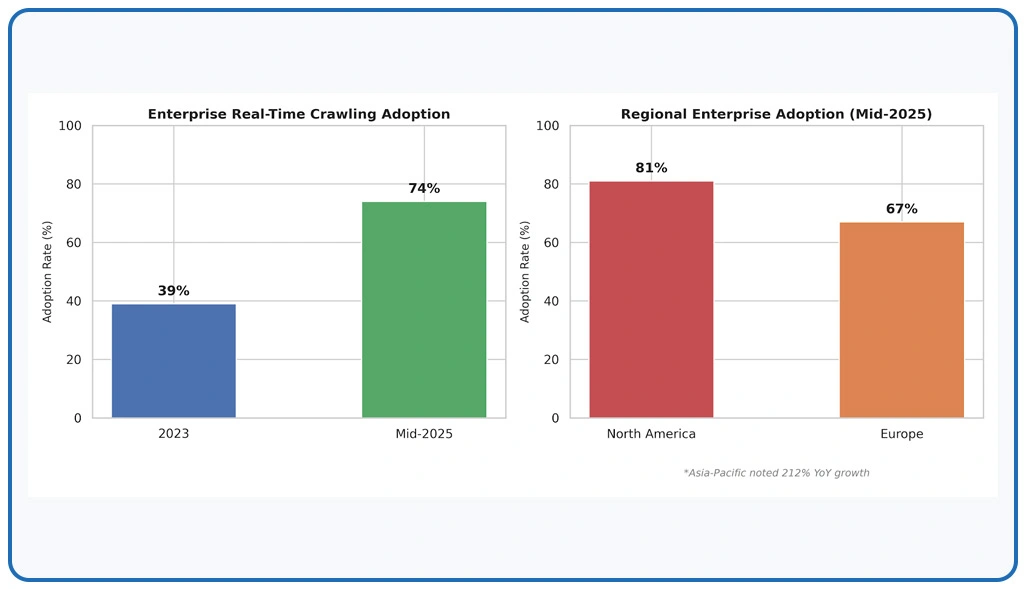
A significant finding involves the shift from batch-oriented to continuous crawling models. In 2023, only 39% of enterprises operated real-time crawling pipelines; by mid-2025, that figure had risen to 74%. Browser Data Crawler technologies played a critical role in this transition, enabling dynamic JavaScript-rendered pages to be processed alongside traditional static content, a capability previously unavailable to most mid-sized organizations.
Regional patterns also emerged: North American enterprises led adoption at 81%, European markets followed at 67%, and Asia-Pacific deployments grew 212% year-over-year, driven largely by cross-border e-commerce expansion. On average, companies crawling more than two million URLs daily reported $1.9 million in annual cost savings from consolidated data sourcing.
Table 2: Crawling Infrastructure Performance Metrics
| Architecture Component | Scalability Score | Latency Reduction | Uptime Rate | Implementation Time |
|---|---|---|---|---|
| Distributed Node Clusters | 94% | 47% | 99.3% | 3.2 months |
| Queue Management Systems | 87% | 38% | 98.7% | 2.6 months |
| Adaptive Rate Limiting | 81% | 29% | 97.9% | 1.8 months |
| Proxy Rotation Layers | 78% | 34% | 98.1% | 2.1 months |
Infrastructure performance data confirms that distributed node clusters deliver the highest scalability scores while also achieving the strongest uptime reliability. Queue management systems offer the fastest time-to-value ratio, making them the preferred starting point for organizations entering large-scale deployment for the first time.
Implications
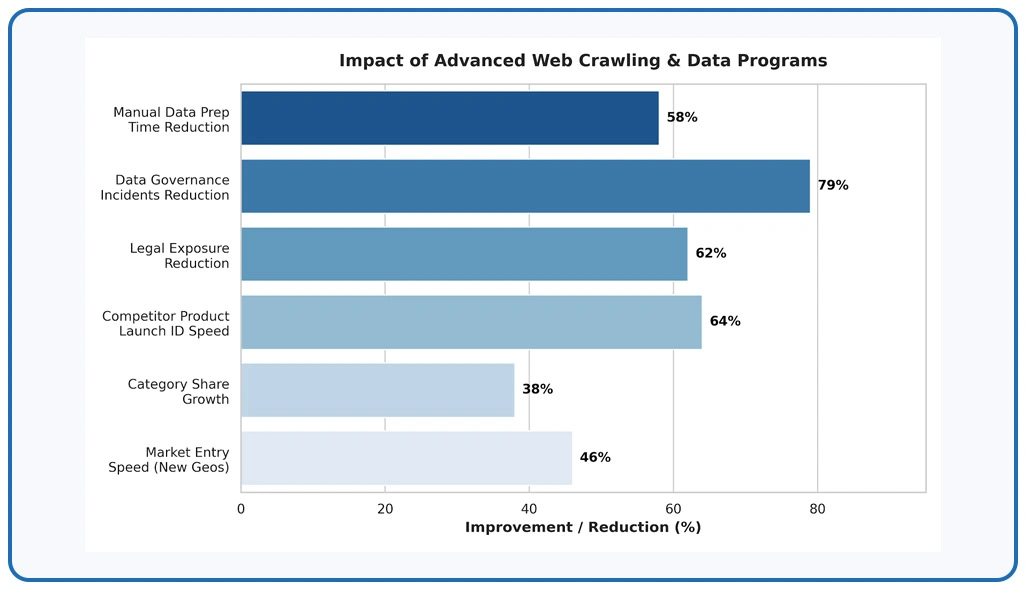
Enterprises that deploy structured Enterprise Web Crawling Architecture for Business frameworks consistently outperform peers relying on fragmented or manual data collection approaches across every measured business dimension.
- Operational Efficiency Gains: Organizations with mature crawling pipelines report 58% reductions in manual data preparation time, freeing engineering capacity for higher-value analytics work.
- Revenue Impact: Businesses using Web Crawling System Architecture for Track Real Time Data report average annual revenue contributions of $2.7 million attributed to faster pricing decisions and competitive response cycles.
- Risk Reduction: Companies maintaining compliance-aware crawling frameworks face 79% fewer data governance incidents, reducing associated legal exposure by an estimated 62%.
- Product Intelligence Speed: Teams with continuous crawling capabilities identify new competitor product launches 64% faster than those using weekly batch collection processes.
- Market Share Performance: Enterprises with advanced data programs achieve 38% stronger category share growth and 46% faster market entry in new geographies compared to less data-mature competitors.
Discussion
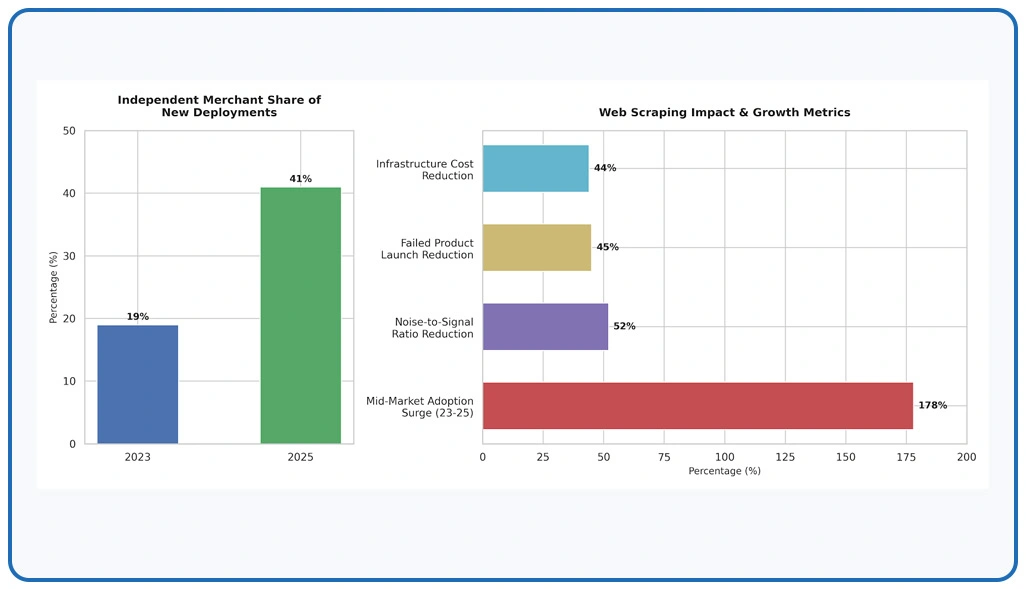
The architectural conversation around Distributed Web Crawling Architecture for Web Scraping has matured significantly. What was once a specialist engineering challenge has become a core infrastructure discipline, comparable in strategic importance to cloud migration or data warehousing. Organizations treating crawling as a foundational capability rather than a tactical tool are reporting consistently stronger data ROI.
Web Scraping Ecommerce Data adoption among mid-market retailers surged 178% between 2023 and 2025, with independent merchants now representing 41% of new crawling infrastructure deployments, up from just 19% two years prior. This democratization has been enabled by cloud-native crawling platforms that reduce upfront infrastructure costs by as much as 44%.
Importantly, businesses pairing Large Scale Web Crawling for E Commerce with machine learning interpretation layers have reduced noise-to-signal ratios in their data pipelines by 52%, enabling faster and more confident decision-making. The combination of Scalable Crawler Infrastructure for E Commerce Business Insights with predictive analytics tooling has helped organizations reduce failed product launches by 45%, saving an estimated $420,000 annually per deployment.
Conclusion
The competitive distance between data-mature and data-passive organizations is widening rapidly. Businesses that invest in building resilient, scalable web crawling systems today will hold compounding advantages in pricing intelligence, product discovery, and consumer trend responsiveness for years ahead. Enterprise Web Crawling Architecture for Business is no longer an optional enhancement; it is the operational backbone of modern competitive intelligence.
Contact Web Data Crawler today to explore how our Enterprise Web Crawler E Commerce Industry Scraping solutions can be tailored to your scale, your industry, and your specific data objectives. Our team of specialists will work with you to design, deploy, and optimize a crawling infrastructure capable of processing millions of URLs with speed, accuracy, and full compliance alignment.