
How Is Category Level Scraping for Market Analysis via Web Scraping Transforming E-Commerce Growth?
May 18
Introduction
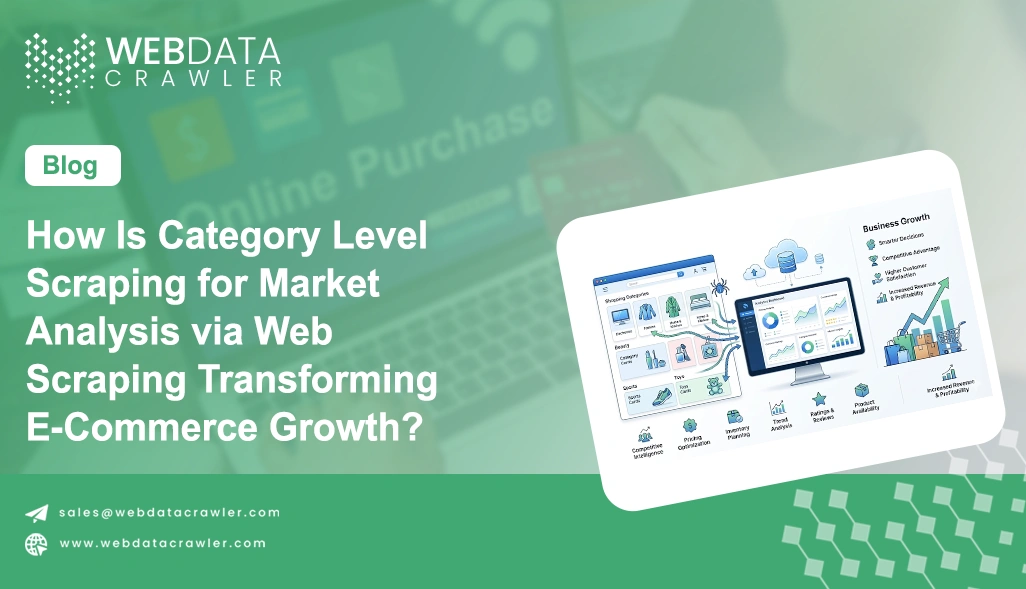
Retailers today operate in an environment where category-level insights shape pricing, assortment, and promotional decisions faster than traditional reporting methods. With thousands of SKUs changing daily, businesses need accurate category intelligence to monitor shifts in demand and consumer buying behavior. This is where Category Level Scraping for Market Analysis via Web Scraping plays a critical role by collecting structured product data from marketplaces, retail apps, and brand stores to reveal hidden trends.
Across global e-commerce platforms, category segmentation now influences nearly 68% of product planning decisions, according to retail analytics reports. Companies use category data to track pricing gaps, identify high-performing subcategories, and monitor stock movement. Data extracted from category pages, filters, and product attributes creates a reliable base for Sentiment Analysis, helping businesses interpret customer response patterns at scale.
Retail analysts increasingly rely on structured category scraping to compare assortment depth, price distribution, and product popularity across competitors. By capturing subcategory listings, customer ratings, and promotional frequency, businesses create better forecasting models. This process supports stronger category planning, faster merchandising actions, and measurable business growth in dynamic online marketplaces.
Understanding Retail Category Performance Through Data

Retail businesses increasingly depend on category-level intelligence to monitor shifting consumer behavior across online marketplaces. Product categories change rapidly as retailers add new SKUs, remove low-performing items, and adjust stock according to demand. Structured category extraction helps companies map these changes across platforms and evaluate how each segment contributes to overall growth.
Businesses use category datasets to compare inventory depth, product variety, and review trends. These insights improve Market Research, especially when analyzing category performance over time. Capturing category movement across marketplaces helps identify rising segments and declining categories before they impact revenue.
Around 72% of online retailers now rely on structured category tracking to improve assortment planning. Category intelligence helps reduce decision delays while improving stock visibility across major platforms.
| Category Metric | Strategic Value |
|---|---|
| Product Count | Category size tracking |
| Stock Levels | Supply planning |
| Ratings | Consumer response |
| Promotions | Campaign insights |
| Listing Growth | Demand changes |
Businesses apply Market Data Scraping Services for Sentiment Analysis to combine category data with customer feedback. This helps identify why certain categories expand faster than others. Review patterns reveal product acceptance and user satisfaction trends.
With Web Scraping for Category Trend Analysis in Retail, companies compare how categories evolve across multiple stores. These insights improve forecasting, identify product opportunities, and support better merchandising strategies. As category visibility grows more important, businesses increasingly depend on structured datasets to evaluate market movement and changing consumer demand.
Monitoring Product Segments Through Pricing Signals
Pricing shifts across product categories often determine how retailers position products and manage promotions. Category-level pricing intelligence allows companies to monitor price changes, discount ranges, and assortment movement without relying on manual checks. Tracking category prices gives a clearer understanding of where customer demand shifts and how competitors adjust pricing structures.
Retailers use category pricing datasets to evaluate market patterns, identify gaps, and improve margin decisions. This process strengthens Pricing Intelligence, especially for fast-changing sectors like electronics, groceries, and beauty products. Category-based price monitoring helps businesses compare premium and value products within each segment.
A recent report found that 64% of retailers using automated pricing analysis improved campaign response time by 26%. A Product Category Scraping API for Retail Analytics Platform automates this process by capturing product metadata, category changes, and live pricing into centralized systems. This improves reporting accuracy and reduces delays.
| Price Indicator | Strategic Purpose |
|---|---|
| Average Price | Benchmarking |
| Discount Level | Promotion mapping |
| Product Spread | Category coverage |
| Rating Value | Product positioning |
| Price Gap | Market comparison |
Retailers often Scrape Subcategory Product Listings With Price and Ratings to collect detailed product records across category branches. This helps compare subcategory performance and customer preference. Tracking ratings alongside prices reveals stronger buying trends.
With category pricing changing daily, businesses use structured monitoring to understand pricing shifts, promotional behavior, and customer response. This creates a stronger foundation for category management and more accurate retail forecasting.
Evaluating Market Position Through Category Comparison

Online retailers need structured competitive visibility to understand how categories perform against rival platforms. Category benchmarking allows businesses to compare assortment size, product ratings, and category expansion across competitors. This process reveals how rivals structure product offerings and adjust to demand trends.
Retailers rely on category comparisons to improve sourcing decisions and market planning. By tracking assortment depth and promotional patterns, companies strengthen Competitive Benchmarking and identify where competitors dominate. These insights help improve category positioning and product planning.
A 2025 retail intelligence report found that businesses using category comparison tools improved assortment optimization by 33%. Competitor category tracking also reduced missed product opportunities by 28%. Category-level analysis reveals how product launches impact rankings, customer engagement, and category share.
| Benchmark Metric | Strategic Use |
|---|---|
| Assortment Size | Market depth |
| Promotions | Sales activity |
| Product Ratings | Consumer trust |
| Category Growth | Expansion patterns |
| Reviews | Brand performance |
Many businesses ask What Is Category-Level Data Scraping in Ecommerce? It refers to extracting product data organized by categories and subcategories to analyze assortment, pricing, and competitor strategies across digital marketplaces. Structured competitor dashboards help retailers compare category movement and identify fast-growing segments.
Businesses use these datasets to understand category gaps, improve sourcing, and strengthen promotional planning. As online competition grows, category intelligence supports faster decisions, stronger portfolio strategies, and improved visibility across digital commerce ecosystems.
How Web Data Crawler Can Help You?
Modern businesses require structured category intelligence to improve product planning and retail forecasting. When brands need faster category visibility, Category Level Scraping for Market Analysis via Web Scraping provides accurate, scalable data collection from e-commerce platforms.
We support businesses by delivering:
- Collecting category and subcategory listings from major marketplaces
- Monitoring price movement across product segments
- Capturing ratings and review-based product signals
- Tracking assortment changes over time
- Supporting dashboard integration for analytics
- Enabling custom category intelligence reports
Businesses also benefit from Web Scraping for Category Trend Analysis in Retail, which supports strategic decisions by combining category movement, competitor activity, and market performance into actionable datasets.
Conclusion
Retail growth increasingly depends on real-time category intelligence. Businesses using Category Level Scraping for Market Analysis via Web Scraping improve category planning, pricing decisions, and competitive monitoring by turning live marketplace data into actionable insights.
Category-based insights become more effective when paired with What Is Category-Level Data Scraping in Ecommerce? as a structured framework for tracking category behavior, assortment shifts, and market demand. Connect with Web Data Crawler to transform category analytics into smarter e-commerce growth strategies.