
How Does Web Scraping Services vs in House Compare on Cost, Scale, Maintenance, and Data Quality?
Aug 25, 2026
Introduction
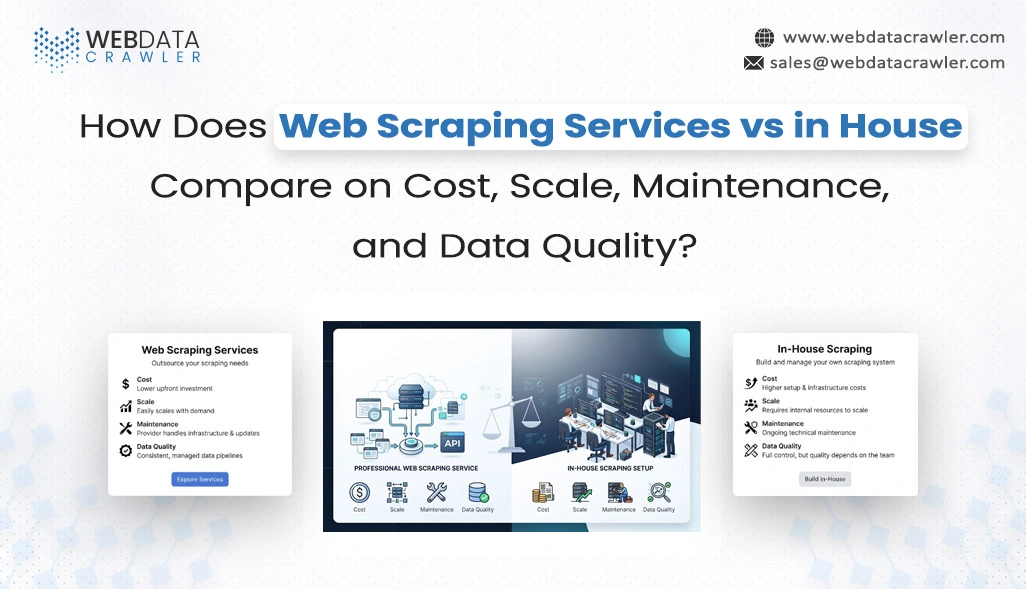
Businesses collecting large volumes of web data often compare internal development with external expertise before selecting a sustainable approach. Web Scraping Services vs in House becomes an important evaluation when teams must balance infrastructure expenses, engineering capacity, maintenance requirements, scalability, and data accuracy across changing sources.
Internal teams can provide direct control, but building reliable crawlers requires developers, infrastructure, monitoring, proxy management, and continuous troubleshooting. Meanwhile, Web Scraping Services can provide specialized resources without requiring companies to establish every component internally. The right model depends on data volume, update frequency, technical complexity, and operational priorities.
Cost alone should not determine the decision. Companies should evaluate the complete lifecycle, including development, maintenance, scaling, quality checks, compliance workflows, and delivery. A structured comparison of Web Scraping Services vs in House helps decision-makers understand which model can support consistent data operations while controlling long-term resource commitments.
Financial Factors Shaping Long-Term Scraping Operations

Building a scraping environment internally requires more than hiring developers. Organizations may need servers, proxy infrastructure, monitoring systems, storage environments, scheduling tools, and dedicated engineering resources. When estimating Web Scraping Service Cost, businesses should include these recurring expenses rather than comparing only initial development charges. This provides a clearer picture of the financial commitment involved.
The delivery model also influences how quickly a business can start collecting information. A managed Web Scraping API can reduce implementation complexity by providing structured access to collected information, while an internal platform may require additional development before production workloads begin. The decision should reflect both immediate requirements and anticipated data expansion over time.
Financial Area and Approach Comparison:
| Financial Area | Internal Development | Managed Approach |
|---|---|---|
| Initial Setup | Higher | Lower |
| Infrastructure | Internally managed | Provider managed |
| Technical Staffing | Dedicated team | Specialist support |
| Scaling Expenses | Variable | More predictable |
Another consideration involves opportunity cost. Engineers maintaining crawlers spend time resolving extraction failures, adapting selectors, managing infrastructure, and handling source changes. Those hours could otherwise support applications, analytics, automation, or customer-facing initiatives. In House vs Outsourced Web Scraping therefore requires comparison of both direct spending and internal resource allocation.
Organizations should also consider how costs behave as workloads increase. A system handling thousands of pages may require modest resources, while millions of URLs can introduce substantially higher infrastructure and operational requirements. A detailed financial assessment should therefore include development, hosting, monitoring, support, scaling, and data delivery before selecting an operating model.
Key financial considerations include:
- Compare initial development requirements
- Calculate recurring infrastructure expenses
- Assess internal engineering capacity
- Estimate costs at larger volumes
Scaling Requirements and Engineering Resource Allocation

Scaling a crawler involves considerably more than increasing server capacity. Large workloads require distributed queues, worker coordination, proxy management, retry mechanisms, scheduling, monitoring, and failure recovery. These components must work together consistently as the number of sources and URLs grows. AI Web Scraping Services can also support complex extraction workflows where changing layouts make purely manual maintenance increasingly difficult.
Internal teams can provide strong technical control, but scaling often requires additional specialists as workloads expand. Engineers may need to optimize crawl distribution, manage concurrency, troubleshoot blocked requests, and improve extraction rules. This can create additional pressure when the same team is responsible for other software development priorities.
Scaling Requirement and Approach Comparison:
| Scaling Requirement | Internal Model | Managed Model |
|---|---|---|
| Worker Management | Internal | Provider handled |
| Queue Expansion | Custom implementation | Scalable infrastructure |
| Monitoring | Team maintained | Managed monitoring |
| New Source Onboarding | Engineering effort | Specialized support |
Another factor is flexibility during demand changes. Businesses may need limited extraction during testing and significantly larger volumes during seasonal campaigns, market research projects, or pricing analysis. Build vs Buy Web Scraping becomes particularly relevant when organizations must determine whether expanding an internal platform is more practical than adopting an established external capability.
Scalability should ultimately be measured through reliability as well as volume. A crawler that processes more URLs but frequently fails, duplicates records, or requires manual intervention may not deliver meaningful operational efficiency. The selected architecture should maintain predictable throughput while allowing teams to adjust collection schedules, sources, and processing requirements without unnecessary engineering overhead.
Key scaling activities include:
- Plan for growing URL volumes
- Evaluate distributed processing requirements
- Assess engineering workload during expansion
- Measure reliability alongside throughput
Maintenance Practices Supporting Reliable Data Quality

Websites continuously change their layouts, HTML structures, scripts, access controls, and content presentation. Consequently, scraping systems require regular monitoring and maintenance to preserve extraction accuracy. Teams operating internal platforms must allocate resources for identifying failures, updating extraction logic, reviewing output, and restoring disrupted workflows. Web Scraping Maintenance Cost can become significant when hundreds of sources require ongoing attention.
External operations can distribute this responsibility across specialized technical teams that monitor source behavior and address recurring extraction issues. Live Crawler Services are useful for workflows where information needs frequent refreshing and collection schedules must respond to changing business requirements. Such models can reduce the amount of day-to-day troubleshooting handled by internal developers.
Quality Factor and Approach Comparison:
| Quality Factor | Internal Model | Managed Model |
|---|---|---|
| Change Monitoring | Internal setup | Provider managed |
| Validation | Custom workflows | Standardized workflows |
| Error Resolution | Internal team | Specialist support |
| Refresh Scheduling | Internally configured | Managed options |
Data quality also depends on validation after extraction. Duplicate detection, missing-value checks, formatting consistency, schema validation, and freshness controls help transform raw responses into usable datasets. These processes are particularly important when information feeds pricing systems, market intelligence platforms, analytics dashboards, or operational applications.
Maintenance requirements should therefore be evaluated over the complete lifecycle rather than during initial deployment. Web Scraping Outsourcing can reduce the internal workload associated with continuous crawler management, particularly when organizations collect information from numerous sources with different technical structures. The most suitable approach depends on required freshness, source complexity, data volume, and internal technical capacity.
Key maintenance activities include:
- Monitor source structure changes
- Validate extracted records consistently
- Track freshness and completeness
- Establish clear recovery procedures
How Web Data Crawler Can Help You?
Organizations evaluating different collection models need an architecture that can support changing websites, growing URL volumes, and business-specific data requirements. We help businesses approach Web Scraping Services vs in House decisions through structured extraction workflows designed around scale, quality, and operational continuity. Its approach can reduce the technical burden associated with managing multiple crawling components internally.
Key capabilities include:
- Scalable crawling across large URL volumes
- Structured extraction aligned with business requirements
- Automated data validation and cleaning
- Flexible scheduling for recurring collection
- Monitoring for crawler failures and source changes
- Delivery through business-ready data formats
A managed approach also helps teams focus internal resources on analytics, strategy, and application development rather than continuous crawler troubleshooting. Businesses can evaluate In House vs Outsourced Web Scraping according to their data volume, technical requirements, maintenance expectations, and long-term operational priorities.
Conclusion
Selecting the right scraping model requires more than comparing development prices. Web Scraping Services vs in House should be evaluated across infrastructure, engineering resources, scalability, maintenance, reliability, and data quality. A solution that appears inexpensive initially can become costly when frequent website changes, monitoring, proxy requirements, and ongoing fixes are included.
For businesses with growing data requirements, a specialized operating model can simplify expansion while keeping internal teams focused on core priorities. Web Scraping Outsourcing can provide access to dedicated technical capabilities without requiring the organization to build every scraping component internally. Talk to Web Data Crawler today to build a scalable, reliable, and cost-efficient web data collection strategy.